
What is the sky? What strikes me immediately, scanning through the wikipedia page (as good a place to start as any), is the rather ineffable nature of the sky, hard to nail down with a single definition. We begin with the understanding that the "sky" is the view of everything not-earth that can be seen from the vantage point of earth — the atmosphere, outer space (and we expand this by saying it is this same view afforded from the surface of "any astronomical object," by which I assume they mean, f'ex, meteors or other plants, not any object that happens to be incredibly large). During the day, you could reasonably say that the sky is only our atmosphere and the few bits of our immediate solar system that manage to assert themselves: the sun, the moon, sometimes very bright planets or comets, but otherwise, the "sky" is that approximately 11 km of atmosphere closest to the earth's surface, where most of its weather takes place. Yet at night, "sky" becomes almost infinite, from our perspective reaching out into the darkness of space where stars trillions of kilometers away are shining, reaching their light towards us from the past. The night sky is (nearly) infinite in both space and time, then, while the day sky is wrapped close around the land. Poetically, you can imagine the sky — as an intentional object (phenomenologically speaking) — breathing or pulsing, in and out, wider and closer, as the earth turns. Strange that the dark, so often associated with a turn inwards towards the center, is also the time when the sky "expands" the farthest.
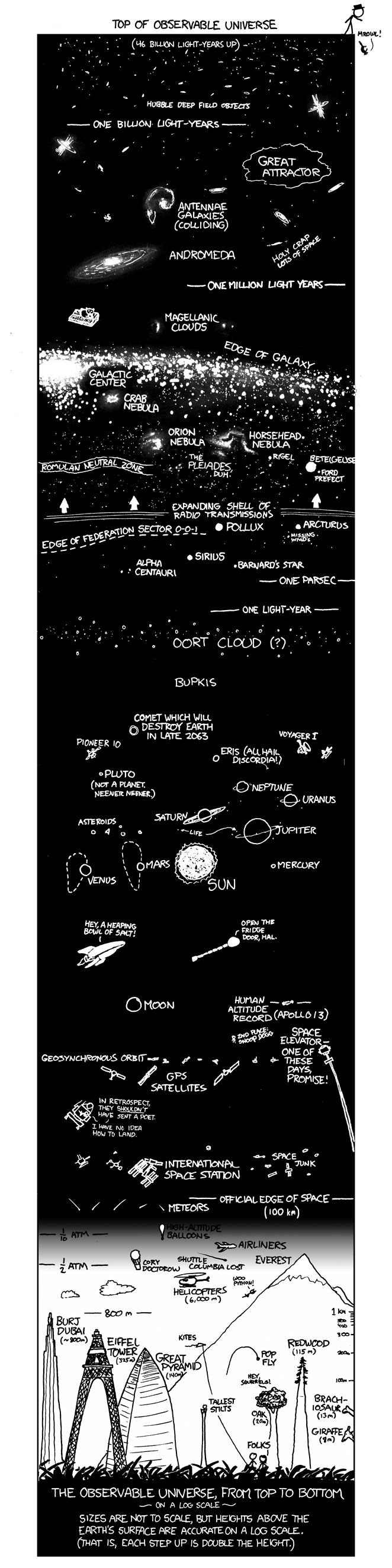 The atmosphere. Some fun facts about the earth's atmosphere. Dry air contains about 78.09% nitrogen, 20.95% oxygen, 0.93% argon, 0.039% carbon dioxide, and small amounts of other gases, as well as an average of about 1% water vapor. The atmosphere acts as a kind of gaseous "skin" enveloping the earth, that both deflects harmful radiation and retains a certain amount of heat from the sun, helping to modulate night and day temperatures.
The atmosphere has five basic layers, delineated according to temperature rise or fall. The troposphere begins at the earth's surface and extends to between 7 km (at the poles) to 17 km (at the equator); within this layer, temperature decreases with an increase in altitude, mainly because of heat transfer from the surface of the earth which makes the lowest part of the troposphere the warmest. The name derives from the Greek "trope" meaning to turn or overturn, and indicates the nature of vertical mixing that occurs within this atmospheric layer. The next layer, the stratosphere, extends from the upper edge of the troposphere to about 51 km, and within this layer temperature increases with altitude, limiting the amount of mixing and turbulence. The lower portion of the stratosphere contains the ozone layer, which can vary in thickness. The mesosphere extends from the upper edge of the stratosphere to about 80-85 km, and is defined by a decrease in temperature as altitude increases. The upper threshold of this level might be considered the "coldest place on Earth" (averaging around -85˚C or -121˚F). Above the mesosphere is the thermosphere, extending to about 690 km above the earth's surface, and in which temperature again increases with height. Within the thermosphere, the Kármán Line (at 100 km) marks what is commonly accepted to be the unofficial "boundary" between earth's atmosphere and outer space, as it indicates the place where the air becomes too thin to be practically useful for aeronautics purposes (in other words, in order to generate enough lift, a vehicle at this altitude would have to travel faster than the orbital velocity). Above the thermosphere is the exosphere, composed primarily of hydrogen and helium, with free-moving molecules so far apart that the atmosphere no longer behaves "like a fluid." Within the exosphere, temperature remains constant; although you could arguably describe the exosphere as ending at about 10,000 km, there really is no hard-and-fast line for its end — rather, it grows progressively thinner and thinner as altitude increases.
Light and color. The daytime sky appears blue because of Rayleigh scattering — shorter wavelength light (such as blue and violet) scatter more than longer wavelength light (such as yellow and especially red), giving the sky a blue gradient in which it appears lighter towards the horizon and darker towards the zenith, while the sun itself appears yellow due to longer-wavelength light from father away not being scattered (from outer space, the sky appears black and the sun appears white). Since I don't exactly understand this (though I have observed this effect with clouds), I'm going to quote directly from the wikipedia article on this one:
In other words, the red light scatters also; if it does so at a point a great distance from the observer it has a much higher chance of reaching the observer than blue light. At distances nearing infinity the scattered light is therefore white. Far away clouds or snowy mountaintops will seem yellow for that reason; that effect is not obvious on clear days, but very pronounced when clouds are covering the line of sight reducing the blue hue from scattered sunlight.
Weather and climate. I have no real insight to include on this particular topic, other than to note the usual distinction between weather (the hot/cold, wet/dry, calm/stormy, clear/cloudy, etc. descriptions) of a local area as the day-to-day changes and conditions, while climate indicates the patterns and averaging of weather in an area over an extended period of time. For more detailed discussion, I'll include the wikipedia page in the sources list. I can also make an effort to consult my National Audubon Society Field Guide to North American Weather
 on a regular basis and record the conditions in my local area as part of my daily diary.
Sources: