I realize I never wrote up about the last two nights of my three night vigil.
Night Two (Friday night, August 17) was a quick and somewhat impromptu meditation quite late (it may have even been technically Saturday morning by the time I got to it, after hanging out with Leah reading Pratchett and watching a couple episodes of the IT Crowd). I didn't do a full formal ritual circle as I'd done the night before, but simply lit Sorta*'s candle and spent some time in silent meditation before drawing a card from the Oracle deck and then spending a bit longer meditating on its meaning.
The card I drew was the Hunter of Gifts — and my half-sober meditations seemed to revolve mostly around the subtle paradox of being a "hunter" of gifts, how this phrase seems to capture the paradox of our relationship with the gods, the delicate blending and balance of work and grace (to put it in more Catholic theological terms), or action and receptivity, effort and acceptance. I have never gone hunting in a literal sense, but I've heard stories about the long hours spent waiting quietly in the woods, moving gently through the trees trying to be unobtrusive as possible, how our ancestors sometimes had to stalk prey for days.... And the sudden appearance of the animal, when it finally arrived, could seem like a gift. A gift is a gift precisely because it is not earned or deserved or exchanged tit-for-tat... it is simply given, freely.
I found this particularly poignant because on this night, I had another object on the altar besides the Oracle deck, the candle and the water (which I drank, as before, to honor and bring into myself the energies of the divination and meditation).... a pendant that is an abstract depiction of a bow and arrow. It seemed a powerful omen that I would draw a card depicting a hunter on this night. (The night before, when I'd drawn the Shaman of Courage card, I'd had a piece of ritual wear that I plan to consecrate to Sorta* for shamanic/journey work on the altar, one that has ties to the deer/stag, which I always invite into the circle with an invocation of its strength and courage.)
Night Three (Saturday, August 18), once again I did a full clearing and blessing of the space while burning incense, lighting the candle with a prayer to Sorta* after some time in meditation. This time, along with the deck, candle, water and incense on the altar, I had another pendant, this one of a bear's paw print, along with Jeff's bear fetish that he allowed me to use. The card I drew during divination was the Shaman of Stars. Using the recorded drumming, I did some journeywork on the meaning of this energy (again, a good synchronicity that on the night I work with the bear's energy, which I've often invoked as "great starry bear" associated with the constellations of Ursa Major and Minor in the northern sky, I would draw a shaman card of the stars)...
Again, I entered into the hollowed cedar and found myself following a spiraling stairwell deep down into the earth. The stairwell itself had close, cool walls of bluish stone studded with "stars" that shone white and gold in the dark and which, on closer look, were various gems and diamonds. At the bottom of the spiral stairwell was a rounded, wooden door on which the image of the Shaman of Stars appeared. I reached out to touch the image, and at my touch the door swung open, giving way to a night scene of green, rolling hills under a star-studded and moonlit sky. I recognized this place as the same hillside I'd seen in meditation more than a year ago when seeking insight from Brigid about her role in my life and my role in hers. The image I'd received then was of me dancing beneath the moon and starlight off alone in ecstasy, while others gathered around a bonfire off in the distance sharing stories and laughing together. I remember feeling a protest in me about how this personal worship, away from the eyes of others, did not seem to me to be what being a "priestess" to the gods was about (I thought instead it was about serving the community and being in the public eye) and how I was chided for that attitude, reminded that tapping into my own deep relationship with the gods was the source of any "priestessing" I would be doing and that I needed to let go of my worry about others' expectations and opinions when it came to that work. This time, there was no one else on the hilltop beneath the starlight.... at least at first. Then I saw a movement, almost like a disturbance in the air, and there was the Shaman of Stars on the hillside, reaching up to pick stars out of the sky like fruit and bringing them down to the earth. He was tall, huge really, and his head seemed to be of an animal nature, with a snout, and he seemed to have antlers, though they were invisible, in which the net of stars would sometimes snag and shiver with the movement of his head so that the stars themselves glimmered. I approached him hesitantly, watching him awhile as he plucked the stars. Then he handed me one — it was cool and light, not heavy, though it was about the size of my fist, with many gleaming facets. I wasn't sure what to do with it, but had the impulse to eat it, so I put it to my mouth. Some rational part of my mind must have objected to eating something hard as a diamond, for I found that I had to crunch it with my teeth, and it shattered into a million tiny shards, like glitter, that I swallowed down with some degree of trepidation and even horror. But as I swallowed, I could feel the shards embedding themselves within me all along my throat and in my chest, sinking into my flesh, passing into my bloodstream and being passed throughout my body until I was shining and glistening on the inside. The heat of my body seemed to melt them somewhat, so that they were wet and almost like liquid. At the drumming call back, I thanked the Shaman of Stars and turned to return through the door and back up the spiral stairwell.
Of all the nights' meditations, this is the one I'm least sure of — the journey work on courage seemed to have some clear and obvious symbolism, the red-mud paint and the dancing naked by the bonfire.... This seemed to be the counterbalance to that night's work, all darkness and starlight and a kind of being anointed on the inside, by eating the star, rather than on the outside with bodypaint like blood. There are also obvious ties back to my work with Brigid, so that I feel that this is also about bringing the gifts of my past relationship with her into this new work that I'm doing. (The Libra-ascendant in me is all ready to be giddy: oooh! a sun goddess and a moon goddess! how balanced! ::headdesk::)
I had intended to complete these vigils with a ritual of integration on the new moon night (Sunday), but decided it wasn't quite the right time. Jeff and I did go out again to Tiger Mountain, where I spent some time in meditation in a small cave among the Talus Rocks, surrounded by rock and root, soil and sky. Obviously, since then, I've had a couple of rough days with inexplicable crankiness — today, though, I'm feeling more enthusiastic and energetic. I'm thinking perhaps that I'll do some work tomorrow night, on the sixth night of the moon, which is also a day of importance to this goddess.
Random discovery yesterday while surfing online: the western (or Pacific) red cedar is not a true cedar, but is actually a member of the cypress family. This is also pretty intriguing, since I've had an intuitive sense of connection with the western red cedar ever since arriving here in Seattle, and it turns out that the cypress is a tree considered sacred to the goddess I am calling Sorta*. Interesting....

Showing posts with label trees. Show all posts
Showing posts with label trees. Show all posts
Wednesday, August 22, 2012
Sunday, May 29, 2011
Pilgrimage to the Angel Oak (and Folly Beach)
I didn't have my camera out very much during this trip (except for this first one, a photograph of the Angel Oak I took before we left), but there were a few occasions when Jeff snuck a few quick shots of me.

The Angel Oak


Me in meditation beneath the Angel Oak, performing the DOTR Three Realms Working (my version, with the Tree as bridge).


At the beach on Jeff's birthday — a few pictures of me enjoying a rare chance to swim in the ocean. (I couldn't see anything because I couldn't wear my glasses!) Apparently, I was out in the water for more than an hour.
The Angel Oak
Me in meditation beneath the Angel Oak, performing the DOTR Three Realms Working (my version, with the Tree as bridge).
At the beach on Jeff's birthday — a few pictures of me enjoying a rare chance to swim in the ocean. (I couldn't see anything because I couldn't wear my glasses!) Apparently, I was out in the water for more than an hour.
Thursday, May 12, 2011
DOTR Lesson 4: Air
Sun: taurus (earth/fixed), 6:07am - 8:26pm
Moon: waxing gibbous, virgo (earth/mutable)
Earth: gorgeous and sunny, bright morning, with an afternoon getting up near 80º with thundershowers
I've done a pretty poor job of keeping up with this diary over the past month or so, but that doesn't mean I haven't continued my spiritual work, as well as work more specifically pertaining to DOTR. Sometimes it's difficult to remember to journal here, just because so much of my work seems to tie back in to my spiritual life and path in one way or another, though perhaps not always in clearly definable ways. In any case, I just finished some meditation on Air (for Lesson 3), and I wanted to spend some time noting a few important bits. But (as to be expected, I suppose), I'm feeling a bit "air headed" and scatter brained at the moment, so don't expect too much coherence.
First, a reflection on Air as an element. On Monday morning, I sat outside and did a simple ritual of meditation and connection with the element of Air (though, thanks to the brilliant weather we've been having, I also made passing acquaintance with Fire in the form of sunlight and, subsequently, sunburn). I haven't been keeping up with my meditation as much as I would like, and there have been plenty of things to distract me (more on that later), so I wasn't able to sink deeply into trance or anything like that. But rather than force it, I simply allowed myself to spend time with the element as it expressed itself in my immediate landscape. I felt the breeze on my skin, listened to it play through the wind chimes in the backyard, and watched as it moved the spiraling incense smoke this way and that, turning first away from me, then surrounding me, then lifting up to disappear into the air above me.
Sitting inside this morning to do meditation, I again watched the incense and not for the first time marveled at how solid the forms of smoke seemed, how they kept their shape (though that shape was definitely mutable and spiraling and every-changing) and I could watch one bend or curl of smoke as it wafted on its own unique journey through the barely moving currents of air in the room until it slowly faded — not so much dissipating as simply disappearing, fading away.
This brings my mind back to the relationship between the four classical elements (earth, air, fire and water) and the three Druidic elements of nwyfre, gwyar and calas. In JMG's Druidry Handbook, I always found the explanation rather dissatisfying. It seems to me that these three v. four are distinct systems of understanding the world, with their own implications, and if that's true then one should be able to bring them to bear on one another. Instead, in the Handbook, the four seem simply an extension of the three — so that the implication is the three are somehow incomplete — and nwyfre seems to morph and change not in any essential way, but more as a matter of convenience, taking on whatever extra role seems necessary. Really, the three Druidic elements as JMG presents them seem like a hobbled version of the four classical elements, less like a three-legged stool than a four-legged chair you've taken a saw to. In our teaching work with Savanah, Jeff and I have tried to develop both an understanding of the three elements as complete in themselves, and an understanding of how the four elements can be understood in relation to the three. Anyone who talks to a twelve year old probably knows that you need to know your shit and have your explanations clear if you want to escape endless scrutiny. It took a while to explain why gwyar was different from water, for instance, and calas not quite the same as earth, and so on. But it's been helpful work, and has forced me to articulate some things in my own approach.
The approach I use now is that the three Druidic elements can be understood as guiding principles or aspects of the world. I understand them, most simply, as form, flow and force (for calas, gwyar and nwyfre). Thus, calas is the principle of form, manifestation, boundaries, limits, distinction and individuality. Gwyar is the principle of flow, exchange, movement, communication, connection and freedom. And nwyfre is the principle of force, energy, initiative, desire (and repulsion), drive and life-force in the kind of spiritual sense. Each of these describes aspects that can be found in absolutely everything in the physical (and nonphysical) world.
How do these relate to the four classical elements of earth, air, fire and water? Here I borrow an understanding from astrology (and as I study more, the more I see how much insight this approach has to offer!). The three Druidic elements can be likened to the three qualities in astrology known as cardinal (corresponding in my understanding with nwyfre), mutable (with gwyar) and fixed (with calas) — for each of the twelve zodiac, a sign is a combination of one of these three aspects with one of the four classical elements. Thus, you have Taurus as fixed earth while Virgo is mutable earth, Leo is fixed fire while Aries is cardinal fire, and so on. The three combined in this way with the four create twelve, each with its own particular expression. Taking a cue from astrology then, I see the three Druidic elements as principles or aspects, and I see the four classical elements as qualities or "building blocks," so to speak. Each of the four classical elements has a quality to it that can be expressed by any of the three principles. Thus earth is dark, cool, dry and heavy; air is bright, light, hot and moist; fire is bright, light, hot and dry, water is dark, cool, moist and heavy. These combination of qualities mean each element has particular associations as well — times, places, objects, tools and other symbols that best exemplify or embody the quality particular to that element. (So, for instance, the seasons: spring as warm and moist, summer as hot and dry, fall as cool and moist, winter as cold and dry.)
But the key here is that each of the elements can be expressed through any of the principles represented by the three Druidic elements. Thus, we can have fire as a quality expressed in calas - that principle of a physical fire which gives it shape and definition in our experiential engagement, which imbues it with a kind of perceivable form, that gives it an edge and a boundary. Fire expressed in gwyar is the process of combustion and consumption, the transformation of fuel into flame through a reaction and exchange. Or, another example, earth in calas is, most simply, the material world itself, all around us, which we experience as a realm of form and manifestation, full of distinct entities with limits, boundaries that bump up against one another. Earth expressed by the principle of nwyfre, on the other hand, is the urge in Spirit itself to manifest through form and limit. It is the spark, the initiative, the force of life that gives rise to form, that seeks to consolidate itself into particular organized entities. It is the energy of nwyfre expressed through the quality of darkness and opacity and heaviness.
These are just preliminary thoughts, and I have work to do to tease out the details and how each combination really works. Some qualities (four elements) seem to have particular affinity with certain principles (three elements). (For instance, the element of water is deeply related to the element or principle of gwyar.) So one thing I want to do during this time of revisiting the four elements through the DOTR work is to explore how each of the four elements is expressed or exemplified or affected by the three Druidic elements as principles of being. I'm hoping my divination work will help with this as well. Not only do I plan to keep studying astrology during this time, but I'm also looking into Erynn Rowan Laurie's book on the ogham, in which she talks about using three full sets (of 20) for three "currents" — chthonic, oceanic and celestial — corresponding to the three realms. My understanding of the three Druidic elements of calas, gwyar and nwyfre is that they also correspond to the three realms… though exactly how they correspond is something I'm still working out, and some of it will depend on my deeper research into this approach to ogham.
In particular, on that note, I find myself wavering between associating calas or gwyar with the chthonic/earthy realm. My two patron deities, Brigid Star Fire and Manannan, seem to dwell in tension with each other, with Brigid very much a deity of sky and the celestial, while Manannan is not only a deity of the ocean, but of the depths and the darkness, so that he also seems connected to the "underground" (as well as the mists that rise from the earth to obscure our way, and the rain that pours from the sky and soaks into the earth, seeking its depths). This is another issue that I have with the DOTR Three Realms practice itself. Maybe because of my aesthetic sense of my need for balance (or because I am overly analytical about these things) — I find myself wanting to reach down to connect with "water" (or more specifically, with gwyar) below instead of with "earthy" aspects associated with calas and the land. For me, the blue, deep, dark, heavy, moist, watery qualities below can then be brought into relationship with the yellow, high, bright, light, dry, fiery celestial energies of nwyfre above…. mixing and mingling and expressing themselves in the green aspects of calas and the land, the realm of form and manifestation.
The tree then, a mighty presence of the land, is a symbol of that bridge and that relationship — reaching its branches and leaves up into the sky for sunlight and air, and reaching its roots deep into the earth in search of water and nutrients…. at both these extremes, you have fluidity, exchange, change and a kind of blurring of boundaries, a liminality where Tree merges with that which is seeks. And then, having received the gifts of the heights and the depths, the fire and the water, these extremes, opposites, are integrated and brought into relationship in such a way that you have the "middle earth," the land we walk upon as a meeting place of these other realms, the realm of unique manifestation and expression, individuality and boundaries. The individual can be lost in the mysteries of the depths just as in the celestial mysteries — there is a dark mysticism as well as a bright mysticism. But the "real world" of sensual, sensory experience, where we know ourselves as distinct entities for the most part (only sometimes sinking into depths or rising to heights where we forget our "selves" completely in union with something greater)… that's the realm of calas, of the land, and the Tree. It seems to me that a daily spiritual practice works best (in my experience, anyway) when it teaches us how to bring the more liminal, fluid mysteries of the depths and the heights and integrate them and express them in the everyday world around us. In Kabbalism, as I understand it, there's the idea of climbing up the tree to reach those heights, and then bringing that energy back down "the lightning strike zigzagging through the ten sefirot. But in this idea, the tree not only reaches up towards the celestial, but down as well, into the depth and darkness of the "underworld," and that energy and experience is brought into relationship from both directions into a center. (Plus, blue + yellow = green, duh!)
Is this "underworld" of watery depths and darkness most appropriately called "chthonic"? I'm not sure — I haven't ever used that term much. Perhaps "oceanic" makes more sense, especially since we tend to think (even if just metaphorically) of the lands kind of "floating" on the oceans (and understanding the underground lakes and rivers, the moistness of caves, and even the liquid molten rock below the earth's crust, it makes a kind of literal sense as well). If that's the case, then, does chthonic fit well with the idea of the Tree as bridge between celestial and oceanic, and the land as a kind of "middle ground" where these two Mysteries are brought into manifestation? I can't answer that, because I don't know enough about what the word "chthonic" is supposed to imply (though my first instinct is to answer no, it doesn't quite fit). Still, the relationship between "fire" and "water" (not as elements, now, but as symbols or representatives of the realms, I guess) is something that seems to rest at the core of my Celtic spirituality…. So it's worth exploring. Perhaps I'll tidy this up a bit and post it to the DOTR group blog for some feedback.
This became a long, rambling exploration in a rather more abstract way than I'd originally intended. This was all sparked by my observation during meditation of the way the incense smoke hung together, spiraling around itself — or, the other day, cast shadows on my arms and chest as I sat in the sunlight — bringing to mind again that this smoke, and the air currents themselves, are still very much expressing themselves in calas. The air currents, though they seem invisible to the human eye, are just as distinct, real things as fire or earth (or water and its slightly less invisible currents). To the birds who fly through the air, or the dogs and other animals navigating by scent, the currents of air are palpable presences, distinct bodies with their own boundaries. A story David Abram tells in his book, Becoming Animal, illustrates this point nicely — he describes one time watching ducks flying into a hard wind, dipping here and there, testing to find the edges of the strongest current of air and where there were slips and gaps in the wall of wind coming at them that they could push their way through. For the ducks, the air was as solid and bounded a thing as the landscapes of hills and valleys, forests and fields that we walk through, looking for our own slips and gaps to help us make our way. So air has expression in calas, in the realm of form and manifestation. The invisible, the unseen still has an active presence in and engagement with the manifest world. And as I watched the incense smoke, I understand that the element of Air, too, has its limits and boundaries.
I did want to talk a little bit about some other work I've been doing, but it seems that most of the morning has passed while I've been writing this (and I haven't even done a tarot card reading!). So I'll wrap things up here and maybe come back to it later. I am going to try to be more diligent in writing down these various reflections and experiences. I swear!
Moon: waxing gibbous, virgo (earth/mutable)
Earth: gorgeous and sunny, bright morning, with an afternoon getting up near 80º with thundershowers
I've done a pretty poor job of keeping up with this diary over the past month or so, but that doesn't mean I haven't continued my spiritual work, as well as work more specifically pertaining to DOTR. Sometimes it's difficult to remember to journal here, just because so much of my work seems to tie back in to my spiritual life and path in one way or another, though perhaps not always in clearly definable ways. In any case, I just finished some meditation on Air (for Lesson 3), and I wanted to spend some time noting a few important bits. But (as to be expected, I suppose), I'm feeling a bit "air headed" and scatter brained at the moment, so don't expect too much coherence.
First, a reflection on Air as an element. On Monday morning, I sat outside and did a simple ritual of meditation and connection with the element of Air (though, thanks to the brilliant weather we've been having, I also made passing acquaintance with Fire in the form of sunlight and, subsequently, sunburn). I haven't been keeping up with my meditation as much as I would like, and there have been plenty of things to distract me (more on that later), so I wasn't able to sink deeply into trance or anything like that. But rather than force it, I simply allowed myself to spend time with the element as it expressed itself in my immediate landscape. I felt the breeze on my skin, listened to it play through the wind chimes in the backyard, and watched as it moved the spiraling incense smoke this way and that, turning first away from me, then surrounding me, then lifting up to disappear into the air above me.
Sitting inside this morning to do meditation, I again watched the incense and not for the first time marveled at how solid the forms of smoke seemed, how they kept their shape (though that shape was definitely mutable and spiraling and every-changing) and I could watch one bend or curl of smoke as it wafted on its own unique journey through the barely moving currents of air in the room until it slowly faded — not so much dissipating as simply disappearing, fading away.
This brings my mind back to the relationship between the four classical elements (earth, air, fire and water) and the three Druidic elements of nwyfre, gwyar and calas. In JMG's Druidry Handbook, I always found the explanation rather dissatisfying. It seems to me that these three v. four are distinct systems of understanding the world, with their own implications, and if that's true then one should be able to bring them to bear on one another. Instead, in the Handbook, the four seem simply an extension of the three — so that the implication is the three are somehow incomplete — and nwyfre seems to morph and change not in any essential way, but more as a matter of convenience, taking on whatever extra role seems necessary. Really, the three Druidic elements as JMG presents them seem like a hobbled version of the four classical elements, less like a three-legged stool than a four-legged chair you've taken a saw to. In our teaching work with Savanah, Jeff and I have tried to develop both an understanding of the three elements as complete in themselves, and an understanding of how the four elements can be understood in relation to the three. Anyone who talks to a twelve year old probably knows that you need to know your shit and have your explanations clear if you want to escape endless scrutiny. It took a while to explain why gwyar was different from water, for instance, and calas not quite the same as earth, and so on. But it's been helpful work, and has forced me to articulate some things in my own approach.
The approach I use now is that the three Druidic elements can be understood as guiding principles or aspects of the world. I understand them, most simply, as form, flow and force (for calas, gwyar and nwyfre). Thus, calas is the principle of form, manifestation, boundaries, limits, distinction and individuality. Gwyar is the principle of flow, exchange, movement, communication, connection and freedom. And nwyfre is the principle of force, energy, initiative, desire (and repulsion), drive and life-force in the kind of spiritual sense. Each of these describes aspects that can be found in absolutely everything in the physical (and nonphysical) world.
How do these relate to the four classical elements of earth, air, fire and water? Here I borrow an understanding from astrology (and as I study more, the more I see how much insight this approach has to offer!). The three Druidic elements can be likened to the three qualities in astrology known as cardinal (corresponding in my understanding with nwyfre), mutable (with gwyar) and fixed (with calas) — for each of the twelve zodiac, a sign is a combination of one of these three aspects with one of the four classical elements. Thus, you have Taurus as fixed earth while Virgo is mutable earth, Leo is fixed fire while Aries is cardinal fire, and so on. The three combined in this way with the four create twelve, each with its own particular expression. Taking a cue from astrology then, I see the three Druidic elements as principles or aspects, and I see the four classical elements as qualities or "building blocks," so to speak. Each of the four classical elements has a quality to it that can be expressed by any of the three principles. Thus earth is dark, cool, dry and heavy; air is bright, light, hot and moist; fire is bright, light, hot and dry, water is dark, cool, moist and heavy. These combination of qualities mean each element has particular associations as well — times, places, objects, tools and other symbols that best exemplify or embody the quality particular to that element. (So, for instance, the seasons: spring as warm and moist, summer as hot and dry, fall as cool and moist, winter as cold and dry.)
But the key here is that each of the elements can be expressed through any of the principles represented by the three Druidic elements. Thus, we can have fire as a quality expressed in calas - that principle of a physical fire which gives it shape and definition in our experiential engagement, which imbues it with a kind of perceivable form, that gives it an edge and a boundary. Fire expressed in gwyar is the process of combustion and consumption, the transformation of fuel into flame through a reaction and exchange. Or, another example, earth in calas is, most simply, the material world itself, all around us, which we experience as a realm of form and manifestation, full of distinct entities with limits, boundaries that bump up against one another. Earth expressed by the principle of nwyfre, on the other hand, is the urge in Spirit itself to manifest through form and limit. It is the spark, the initiative, the force of life that gives rise to form, that seeks to consolidate itself into particular organized entities. It is the energy of nwyfre expressed through the quality of darkness and opacity and heaviness.
These are just preliminary thoughts, and I have work to do to tease out the details and how each combination really works. Some qualities (four elements) seem to have particular affinity with certain principles (three elements). (For instance, the element of water is deeply related to the element or principle of gwyar.) So one thing I want to do during this time of revisiting the four elements through the DOTR work is to explore how each of the four elements is expressed or exemplified or affected by the three Druidic elements as principles of being. I'm hoping my divination work will help with this as well. Not only do I plan to keep studying astrology during this time, but I'm also looking into Erynn Rowan Laurie's book on the ogham, in which she talks about using three full sets (of 20) for three "currents" — chthonic, oceanic and celestial — corresponding to the three realms. My understanding of the three Druidic elements of calas, gwyar and nwyfre is that they also correspond to the three realms… though exactly how they correspond is something I'm still working out, and some of it will depend on my deeper research into this approach to ogham.
In particular, on that note, I find myself wavering between associating calas or gwyar with the chthonic/earthy realm. My two patron deities, Brigid Star Fire and Manannan, seem to dwell in tension with each other, with Brigid very much a deity of sky and the celestial, while Manannan is not only a deity of the ocean, but of the depths and the darkness, so that he also seems connected to the "underground" (as well as the mists that rise from the earth to obscure our way, and the rain that pours from the sky and soaks into the earth, seeking its depths). This is another issue that I have with the DOTR Three Realms practice itself. Maybe because of my aesthetic sense of my need for balance (or because I am overly analytical about these things) — I find myself wanting to reach down to connect with "water" (or more specifically, with gwyar) below instead of with "earthy" aspects associated with calas and the land. For me, the blue, deep, dark, heavy, moist, watery qualities below can then be brought into relationship with the yellow, high, bright, light, dry, fiery celestial energies of nwyfre above…. mixing and mingling and expressing themselves in the green aspects of calas and the land, the realm of form and manifestation.
The tree then, a mighty presence of the land, is a symbol of that bridge and that relationship — reaching its branches and leaves up into the sky for sunlight and air, and reaching its roots deep into the earth in search of water and nutrients…. at both these extremes, you have fluidity, exchange, change and a kind of blurring of boundaries, a liminality where Tree merges with that which is seeks. And then, having received the gifts of the heights and the depths, the fire and the water, these extremes, opposites, are integrated and brought into relationship in such a way that you have the "middle earth," the land we walk upon as a meeting place of these other realms, the realm of unique manifestation and expression, individuality and boundaries. The individual can be lost in the mysteries of the depths just as in the celestial mysteries — there is a dark mysticism as well as a bright mysticism. But the "real world" of sensual, sensory experience, where we know ourselves as distinct entities for the most part (only sometimes sinking into depths or rising to heights where we forget our "selves" completely in union with something greater)… that's the realm of calas, of the land, and the Tree. It seems to me that a daily spiritual practice works best (in my experience, anyway) when it teaches us how to bring the more liminal, fluid mysteries of the depths and the heights and integrate them and express them in the everyday world around us. In Kabbalism, as I understand it, there's the idea of climbing up the tree to reach those heights, and then bringing that energy back down "the lightning strike zigzagging through the ten sefirot. But in this idea, the tree not only reaches up towards the celestial, but down as well, into the depth and darkness of the "underworld," and that energy and experience is brought into relationship from both directions into a center. (Plus, blue + yellow = green, duh!)
Is this "underworld" of watery depths and darkness most appropriately called "chthonic"? I'm not sure — I haven't ever used that term much. Perhaps "oceanic" makes more sense, especially since we tend to think (even if just metaphorically) of the lands kind of "floating" on the oceans (and understanding the underground lakes and rivers, the moistness of caves, and even the liquid molten rock below the earth's crust, it makes a kind of literal sense as well). If that's the case, then, does chthonic fit well with the idea of the Tree as bridge between celestial and oceanic, and the land as a kind of "middle ground" where these two Mysteries are brought into manifestation? I can't answer that, because I don't know enough about what the word "chthonic" is supposed to imply (though my first instinct is to answer no, it doesn't quite fit). Still, the relationship between "fire" and "water" (not as elements, now, but as symbols or representatives of the realms, I guess) is something that seems to rest at the core of my Celtic spirituality…. So it's worth exploring. Perhaps I'll tidy this up a bit and post it to the DOTR group blog for some feedback.
This became a long, rambling exploration in a rather more abstract way than I'd originally intended. This was all sparked by my observation during meditation of the way the incense smoke hung together, spiraling around itself — or, the other day, cast shadows on my arms and chest as I sat in the sunlight — bringing to mind again that this smoke, and the air currents themselves, are still very much expressing themselves in calas. The air currents, though they seem invisible to the human eye, are just as distinct, real things as fire or earth (or water and its slightly less invisible currents). To the birds who fly through the air, or the dogs and other animals navigating by scent, the currents of air are palpable presences, distinct bodies with their own boundaries. A story David Abram tells in his book, Becoming Animal, illustrates this point nicely — he describes one time watching ducks flying into a hard wind, dipping here and there, testing to find the edges of the strongest current of air and where there were slips and gaps in the wall of wind coming at them that they could push their way through. For the ducks, the air was as solid and bounded a thing as the landscapes of hills and valleys, forests and fields that we walk through, looking for our own slips and gaps to help us make our way. So air has expression in calas, in the realm of form and manifestation. The invisible, the unseen still has an active presence in and engagement with the manifest world. And as I watched the incense smoke, I understand that the element of Air, too, has its limits and boundaries.
I did want to talk a little bit about some other work I've been doing, but it seems that most of the morning has passed while I've been writing this (and I haven't even done a tarot card reading!). So I'll wrap things up here and maybe come back to it later. I am going to try to be more diligent in writing down these various reflections and experiences. I swear!
Thursday, November 25, 2010
Flamekeeping Meditation
Fire and Water in the Earth of my body,
I honor you, Brigid, Bright Goddess of Flame,
I honor you, Lady of Wellspring and Starlight,
And inscribe in my heart your thrice-holy name.
The candle is the center way, open between the worlds. I hold my hands as though in prayer, then slowly bring them apart to rest, palms upturned, on my knees. Above the soft sound of my breath as it rocks back and forth, ebb and flow within my body — the rustle of the wind in tree branches.
I am in a forest, rich and thick with the scent of evergreen. Tall pines stand all about me like the buttresses and columns of a great cathedral, shivering and shifting in a breeze. I feel as though I can sense every thin, green needle spread like whiskers, scenting the wind, turning this way and that. I stand in awe for a moment, unsure where to go or what to do. I place my hand against the rough, red trunk of one of the trees. Sticky sap seeps beneath my fingers, clinging to my skin.
A figure behind me — it is She, the Bright Goddess, this time draped in subtle, shifting green like the pine trees, her hair in radiant, auburn braids plaited thick and draped about her shoulders like a luxuriant fringe. "Taste," she seems to say with a small gesture, "the sap is sweet." Like the amber was once, I find myself thinking as I raise my fingertips to my lips and lick the sap from my hands. "The amber that once flowed through the veins of ancient trees," she agrees. "What is it that makes the sap sweet?" I do not know how to answer her. "It is the connection between earth and sky, the roots seeking deep for water, the limbs reaching, striving towards sunlight." She watches me as my gaze drifts beyond her back to the great trees of the forest. They seem to dwarf both of us, and I'm struck again by how small her form is. "It is the movement between the realms, the connection that flows through living veins, that makes the sap sweet."
I kneel down at her feet as she speaks these words. But she raises me up again with a gesture or a glance, or simply by her refusal to be an object of groveling or subordination. What do I need, what can you give me as guidance and aid? I try to ask her. But she says, almost sharply, "You already have everything you need." The amber sun — "Yes, the drop of liquid fire, the sweet sap of life-blood connecting the three realms. And the spiral shell? She smiles and looks to the new amulet I now where around my neck, the blue goldstone surrounding the glistening spiral forged of silver. "The dark waters of space, the depths of source and creation — do you think this amulet is so different from the spiral shell you were given at the wellspring?" And the sword? The missing piece, the gift I could not yet quite see — is it the sword of starlight? The simple athame? In answer, I find the small knife in my hands, lengthening into a sword glistening, pulsing with a light of its own, starlight or moonlight in the twilight beneath the trees.
I swing the sword, as though to test its sharpness and my strength. It slices through the image of the lady standing before me, slices it in half as though a flimsy veil, and the reality of the woods flap loose like a rip in space itself. Through the tear, a glimpse of dark night scattered brilliant with endless stars. I peer through, and seem to hear her voice coming from that beyond-place, reassuring me that I have not hurt her, only cut down the image of her to a larger reality. I wonder if this is the threshold between my inner landscape and the deep places of the realms beyond, the collective unconscious, the place of Spirit and soul. I remember the card I drew this morning, the image of the wanderer stepping out onto the thin earth-bridge made by the very act of stepping, a bridge created by the journey. I step through the tear and into the gulf of space.
Below my feet, it seems a thin foot bridge solidifies, bearing up my weight. I step again, moving farther out into space, and farther. The bridge, which at first seemed made of earth and brown stone, starts to sweat star-stuff like condensation, drips of night sky gathering like dew along its edges, running down the slope back towards the rip in space that leads back into the pine forest. The droplets of star-fire space sparkle darkly like pieces of tumbled blue goldstone, and I gather a few as amulets and charms, thinking somehow to bring them back for others. The bridge beneath my feet is soon coated completely with the shimmering dark surface, lit from within and glittering with stars, so that the bridge itself seems made of night and starlight instead of earth. All about me, the black abyss of space yawns open, the distance and nothingness sending a brief sense of thrilling vertigo through my body. Still, I keep walking — ahead of me, She is there again, her hair loose and flickering upwards like a flame, her form now draped in dark blue velvet robes that catch what little light there is in this place.
I can go no further, but far in the distance I seem to see the faint flickering of orange forge fire. I ask her if she can take me there, to the place where the stars are forged. She takes both my hands in hers and lifts me gently from the bridge, waltzing me across the distances, our feet trailing rippling mists like the tails of comets. When we reach the forge, it glows warm and pulsing like an ember nestled in a cave-like nook of nighttime. The hiss of steam and the noise of the bellows surround us, the ringing sting of the hammer against the anvil — and I see the forms being created there, tiny round discs of silver with curling rays, like miniature suns. They look quite like my own sun charm, except that their centers are empty. I ask this goddess of the Star Forge where is the amber, why the charms are incomplete. "Don't you see?" she seems to say. "These are only tools and symbols, but the amber is the life-blood, upwelling from the source — it must arise from you, from your life and your work. Only then will the sun become complete."
My mind wanders to the prayer beads I have crafted, and how I might make more to use as a tool for prayer. She laughs at me as though indulging the amusing obsessions of her child, chiding me a little for always wanting so much to make things, instead of allowing my work to be the upwelling of my life to fill in and complete what I have made. As I ponder this thought, I seem to hear the ocean waves in rhythm on the shore. In time with my breathing, they seem to draw me back to my inner landscape, and I find myself wandering down out of the tall pine forest to the pebbly beach, the ocean stretching out deep blue and etched with rising star light as, on the western horizon over the mountain, the sky blazes orange and red with the sunset. I sit for a little while, watching the dusk fade to blues and purples, holding a small memory of that fiery sunset within me as I prepare to keep the flame from this sunset to the next.
Bring my hands together again, I bow my head in gratitude for the wisdom shared. I slip the small flamekeeping pendant over my head, and breathe deeply as I sing my awen and promise to carry Brigid's Fire and Water in the Earth of my body. The meditation has ended, and I speak the words of peace as my breath moves through me like the tides beneath a night sky.
I honor you, Brigid, Bright Goddess of Flame,
I honor you, Lady of Wellspring and Starlight,
And inscribe in my heart your thrice-holy name.
The candle is the center way, open between the worlds. I hold my hands as though in prayer, then slowly bring them apart to rest, palms upturned, on my knees. Above the soft sound of my breath as it rocks back and forth, ebb and flow within my body — the rustle of the wind in tree branches.
I am in a forest, rich and thick with the scent of evergreen. Tall pines stand all about me like the buttresses and columns of a great cathedral, shivering and shifting in a breeze. I feel as though I can sense every thin, green needle spread like whiskers, scenting the wind, turning this way and that. I stand in awe for a moment, unsure where to go or what to do. I place my hand against the rough, red trunk of one of the trees. Sticky sap seeps beneath my fingers, clinging to my skin.
A figure behind me — it is She, the Bright Goddess, this time draped in subtle, shifting green like the pine trees, her hair in radiant, auburn braids plaited thick and draped about her shoulders like a luxuriant fringe. "Taste," she seems to say with a small gesture, "the sap is sweet." Like the amber was once, I find myself thinking as I raise my fingertips to my lips and lick the sap from my hands. "The amber that once flowed through the veins of ancient trees," she agrees. "What is it that makes the sap sweet?" I do not know how to answer her. "It is the connection between earth and sky, the roots seeking deep for water, the limbs reaching, striving towards sunlight." She watches me as my gaze drifts beyond her back to the great trees of the forest. They seem to dwarf both of us, and I'm struck again by how small her form is. "It is the movement between the realms, the connection that flows through living veins, that makes the sap sweet."
I kneel down at her feet as she speaks these words. But she raises me up again with a gesture or a glance, or simply by her refusal to be an object of groveling or subordination. What do I need, what can you give me as guidance and aid? I try to ask her. But she says, almost sharply, "You already have everything you need." The amber sun — "Yes, the drop of liquid fire, the sweet sap of life-blood connecting the three realms. And the spiral shell? She smiles and looks to the new amulet I now where around my neck, the blue goldstone surrounding the glistening spiral forged of silver. "The dark waters of space, the depths of source and creation — do you think this amulet is so different from the spiral shell you were given at the wellspring?" And the sword? The missing piece, the gift I could not yet quite see — is it the sword of starlight? The simple athame? In answer, I find the small knife in my hands, lengthening into a sword glistening, pulsing with a light of its own, starlight or moonlight in the twilight beneath the trees.
I swing the sword, as though to test its sharpness and my strength. It slices through the image of the lady standing before me, slices it in half as though a flimsy veil, and the reality of the woods flap loose like a rip in space itself. Through the tear, a glimpse of dark night scattered brilliant with endless stars. I peer through, and seem to hear her voice coming from that beyond-place, reassuring me that I have not hurt her, only cut down the image of her to a larger reality. I wonder if this is the threshold between my inner landscape and the deep places of the realms beyond, the collective unconscious, the place of Spirit and soul. I remember the card I drew this morning, the image of the wanderer stepping out onto the thin earth-bridge made by the very act of stepping, a bridge created by the journey. I step through the tear and into the gulf of space.
Below my feet, it seems a thin foot bridge solidifies, bearing up my weight. I step again, moving farther out into space, and farther. The bridge, which at first seemed made of earth and brown stone, starts to sweat star-stuff like condensation, drips of night sky gathering like dew along its edges, running down the slope back towards the rip in space that leads back into the pine forest. The droplets of star-fire space sparkle darkly like pieces of tumbled blue goldstone, and I gather a few as amulets and charms, thinking somehow to bring them back for others. The bridge beneath my feet is soon coated completely with the shimmering dark surface, lit from within and glittering with stars, so that the bridge itself seems made of night and starlight instead of earth. All about me, the black abyss of space yawns open, the distance and nothingness sending a brief sense of thrilling vertigo through my body. Still, I keep walking — ahead of me, She is there again, her hair loose and flickering upwards like a flame, her form now draped in dark blue velvet robes that catch what little light there is in this place.
I can go no further, but far in the distance I seem to see the faint flickering of orange forge fire. I ask her if she can take me there, to the place where the stars are forged. She takes both my hands in hers and lifts me gently from the bridge, waltzing me across the distances, our feet trailing rippling mists like the tails of comets. When we reach the forge, it glows warm and pulsing like an ember nestled in a cave-like nook of nighttime. The hiss of steam and the noise of the bellows surround us, the ringing sting of the hammer against the anvil — and I see the forms being created there, tiny round discs of silver with curling rays, like miniature suns. They look quite like my own sun charm, except that their centers are empty. I ask this goddess of the Star Forge where is the amber, why the charms are incomplete. "Don't you see?" she seems to say. "These are only tools and symbols, but the amber is the life-blood, upwelling from the source — it must arise from you, from your life and your work. Only then will the sun become complete."
My mind wanders to the prayer beads I have crafted, and how I might make more to use as a tool for prayer. She laughs at me as though indulging the amusing obsessions of her child, chiding me a little for always wanting so much to make things, instead of allowing my work to be the upwelling of my life to fill in and complete what I have made. As I ponder this thought, I seem to hear the ocean waves in rhythm on the shore. In time with my breathing, they seem to draw me back to my inner landscape, and I find myself wandering down out of the tall pine forest to the pebbly beach, the ocean stretching out deep blue and etched with rising star light as, on the western horizon over the mountain, the sky blazes orange and red with the sunset. I sit for a little while, watching the dusk fade to blues and purples, holding a small memory of that fiery sunset within me as I prepare to keep the flame from this sunset to the next.
Bring my hands together again, I bow my head in gratitude for the wisdom shared. I slip the small flamekeeping pendant over my head, and breathe deeply as I sing my awen and promise to carry Brigid's Fire and Water in the Earth of my body. The meditation has ended, and I speak the words of peace as my breath moves through me like the tides beneath a night sky.
Tuesday, November 16, 2010


DOTR Lesson 2: Earth
Do not be selfish with your life.
Do not waste your days
inventing ways to change the world
to suit your small ideas.
Do this:
Go out under the open, cloudless sky
and listen to the silence of autumn.
Sit on the rock where once someone carved
a serpent and a star, worn now
by the rain and half-covered
with fallen leaves.
In the sun, your skin is hot
with the pulse of your blood.
In the shade, your skin is cool
with the tides of your breath.
And you are made of this,
flux and form, shifting
in the sunlight of the silent afternoon.
Do this:
Sit on the rock and watch
as the low sun moves
without moving
between the dark
columns of the trees.
Let the fly alight
on your upturned hand
and nuzzle your thumb
where it shimmers, the ridges
of your fingerprints rippling
under its furry, iridescent paws.
An eye studded with diamonds.
Wings translucent, opalescent,
like the cells of your body
woven through with black veins.
There is nothing that moves
in this world but this fly,
who comes and goes despite
the nearness of winter
and thinks nothing
but that the flesh of your body
is soft and sweet-smelling
and sturdy enough, and good.
Do this one thing:
do not be selfish with your life.
Do not imagine that this moment
is somehow less than the dreams
you carry with you, or the silence
into which the fly eventually
wanders, unafraid.
The sun slips behind another tree.
Look up and see, illuminated in
webs of twigs and tree limbs
against the shadowed hills beyond,
the same iridescent pattern
of the fly's wing
in the forest.
Bright twining world,
you do not owe us anything
but this.
Do not waste your days
inventing ways to change the world
to suit your small ideas.
Do this:
Go out under the open, cloudless sky
and listen to the silence of autumn.
Sit on the rock where once someone carved
a serpent and a star, worn now
by the rain and half-covered
with fallen leaves.
In the sun, your skin is hot
with the pulse of your blood.
In the shade, your skin is cool
with the tides of your breath.
And you are made of this,
flux and form, shifting
in the sunlight of the silent afternoon.
Do this:
Sit on the rock and watch
as the low sun moves
without moving
between the dark
columns of the trees.
Let the fly alight
on your upturned hand
and nuzzle your thumb
where it shimmers, the ridges
of your fingerprints rippling
under its furry, iridescent paws.
An eye studded with diamonds.
Wings translucent, opalescent,
like the cells of your body
woven through with black veins.
There is nothing that moves
in this world but this fly,
who comes and goes despite
the nearness of winter
and thinks nothing
but that the flesh of your body
is soft and sweet-smelling
and sturdy enough, and good.
Do this one thing:
do not be selfish with your life.
Do not imagine that this moment
is somehow less than the dreams
you carry with you, or the silence
into which the fly eventually
wanders, unafraid.
The sun slips behind another tree.
Look up and see, illuminated in
webs of twigs and tree limbs
against the shadowed hills beyond,
the same iridescent pattern
of the fly's wing
in the forest.
Bright twining world,
you do not owe us anything
but this.
Wednesday, October 27, 2010
DOTR Lesson 2: Sky
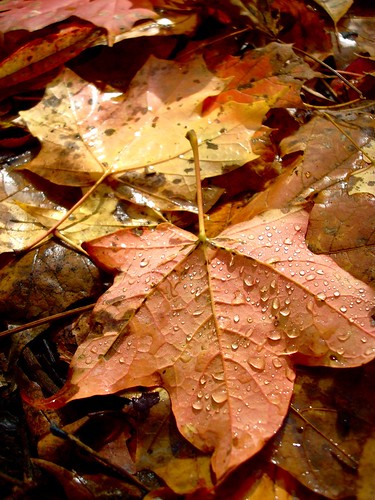
Sunrise in Autumn
I saw
for one brief moment
the light
creeping over the hill
between horizon and fog,
everywhere suffused
with the rose and gold
of morning —
as though we turned
and moved
in joy,
as though we, like all beings,
could reach out
our hands
to cup the day and drink.
The sun rose into cloud,
obscured.
What had lingered
rustling in the shining
crowns of the trees
retreated
into mist.
Now the rooftops
and the bark of the trees
glisten
darkly
with the rainy
dawn and gloom
and everything is still
and wet
and shadowless.
Peace, friends, I say
to the trees.
This too is a kind of light.
And like them,
like all beings, slowly
I open my hands.
Subscribe to:
Posts (Atom)