Showing posts with label lesson 2. Show all posts

Saturday, December 18, 2010

DOTR Lesson 2: Entering the Order as an Aspirant

Tonight during the Druid Order of the Three Realm Mother Grove's winter solstice ritual, I was officially welcomed into the Order as an aspirant working through the Nine Lessons with the intention of becoming a full Druid member after a year's time of study. Though the ritual took place down in Georgia where the Mother Grove is located, my mentor asked me to spend some time in silent Awen meditation between 7:30 and 8:00 pm, to connect with the ritual in my own way.

I also took this opportunity to complete the final section of Lesson Two, the "mini" three realms working. Reaching up to touch sky and down to touch earth, I brought them together through the flow of the sea to create a sacred space in which I infused my intention with energy and enchantment, naming my formal dedication to the work of the aspirant.

Before this, however, I spent some time acknowledging my gods, and in particular Brigid, by pouring some libations and reciting the Druid Prayer for Peace. After some time in meditation, I allowed myself to slip further into trance (though this was a little difficult because Jeff's voice drifted up from downstairs where he sat reading to the children before bed). Deeper in trance, I seemed to stand as part of a circle of shadowed, half-seen figures gathered around a central flame. It seemed to me these figures moved and turned with the gestures of solemn rite, and murmured prayers of awen and welcome. I could not see them well, but it seemed to me that this was the Druid Order of the Three Realms gathered together, some in body and some only in spirit, working together the rituals of the turning year. I asked that I may enter more fully into the Order as an aspirant member, and for a moment the figures seemed to come into sharper focus and full color, before the trance slipped too quickly away and I was spun back into ordinary consciousness. The experience was too fleeting to be sure of anything, but still, it had the feeling of a confirmation and welcoming to become a member of the group.

Following this brief meditation, as the end of the ritual was drawing near, I drew a divination reading using my tarot deck. Using a three-card spread, I asked three questions:

(a) What gift do I have to share with the Order?

(b)What gift does the Order offer to me?

(c) What sign will be my guide and help me along this path?


(a) Queen of Wands: A figure of poise and grace within skillful activity and commitment, the Queen of Wands brings dedication and enthusiasm to her work, as well as a self-confidence grounded in experience and sincerity. She can be an energizing presence for those around her as she follows her natural penchant for energetic involvement in the activities she finds engaging. This card suggests that it is my self-disciplined dedication and steady involvement in the Order that may be my most valuable gift, especially if it comes through the skills and talents that I am most passionate about and have worked hard to cultivate (for instance, my writing and poetry). My energy and enthusiasm for the work may engage others, stimulating them into renewed activity and engagement with the work as well.

(b) Four of Pentacles: This card is often interpreted as one of stagnation and immovability, especially when it comes to securing financial or material wealth. There is a suggestion with this card that things have become too stiff and unchanging, and that we may be clinging to "the way things are" in order to protect our material gains at the expense of openness, receptivity and generosity with others. The spirit of growth and exploration may be missing, as we lock down on our possessions and create a trap or cage of our own making with our covetous spirit. It is not exactly a card you might expect in a reading about gifts. This may mean two things. The first is that, perhaps, the Order itself is perhaps, even if only to a small extent, "locked in" to a particular way of doing things and has grown protective of this structure and approach to the detriment of new growth and experimentation. It may be that the gift the Order has to offer me is in the confrontation with this attitude, in which I may learn to navigate and negotiate with it to both my own benefit and the benefit of the Order itself. The second possibility is that this card is meant to present both stability and protectiveness, especially when it comes to community. The number four represents the stabilization and concretization of the active patterns of three into matter and form, and the pentacles especially is a card of earth, the material world and its manifestation. Thus, this card may indicate that what the Order offers me is a place of stability and structure that is protected by those who have cultivated it and feel deeply invested in it personally. It may offer a "concrete" real community that is close-knit and which gathers regularly to practice together in the physical world, something that is not necessarily true for the groups I've been involved with until now. I am not sure which of these interpretations will prove to be the correct one, or if there will be a mixture of the two that will provide both gift and challenge.

(c) Queen of Pentacles: Grounded in the strength and stability of the earth and the mighty oak tree, this Queen is one of creative energy and harmony that stretches out in all directions, connecting all creatures and beings of the world. Cheerful, though also often humble (from humus, "of the earth") and inwardly turned, she takes great pleasure and enjoyment in the beauties of the world, and shares these joys with others in ways that encourage involvement and growth. She provides a warm embrace for others that encourages them to be themselves, though in ways that express maturity and consideration for the greater world that we share with one another. This card seems to suggest to me that my "guiding sign" as I work through the Nine Lessons towards becoming a full member of DOTR will be a more open, mature, creative and joy-filled engagement with the physical world and the community I am now entering. Together with the Four of Pentacles, it suggests that perhaps this sign is meant to point the way, not necessarily indicate where I can expect to start out, and that there may be a journey ahead of me to move from the more possessiveness and stagnation of the Four of Pentacles, to the receptivity and creativity of the Queen of Pentacles. Because this card also appeared in my full moon ritual dedicated to Brigid of the Star Fire, and because the figure in this deck is depicted in a way that reminds me so much of Brigid, I also understand this card to mean that I should continue my devotions to Brigid and the Lady of the Stars group as an important part of my DOTR aspirant work.

Having completed my divination reading, I then performed the "mini" Three Realms Working found at the end of Lesson Two, setting my intention to commitment to this work and follow the path towards becoming a full member of the Order in a year.

Some time this week or next, hopefully, I will have time to go for a walk in the woods to gather a stone for the final rite of Lesson Two and then move on to Lesson Three. Because of solstice, Christmas, family obligations and travel, and I am not sure how easy this will be. However, I'm hoping that perhaps while I am in Lancaster, I might be able to gather a stone from the local landscape where I was born, to connect to the energies of my family and my ancestors.

Wednesday, December 8, 2010

DOTR Lesson 2: Honoring the Ancestors

Ancestors of My Blood
  • Charlie and Diane, my parents
  • my grandmothers and grandfathers, I cannot remember their names or ever meeting them except for Nana Jule, my father's mother; only my mother's mother is still alive
  • my father's family comes originally from Ireland and crossed the ocean fleeing the Irish Potato Famine in the mid-1800s; they settled in central Pennsylvania, in coal country, and worked the mines there, some of them intermarrying with Welsh descendants already living in the area
  • I do not know anything about my mother's family, except that she has German, Welsh, English and a bit of French blood flowing in her veins; disowned by her family shortly after I was born, we have hardly any contact with her siblings and no contact with her parents


Ancestors of the Land of My Birth
(Lancaster, Lancaster County, PA)
  • Susquehannocks ("people of the muddy river"), an Iroquoian-speaking tribe also known as the Conestoga, lived along the Susquehanna River in what eventually became New York, Pennsylvania and Maryland (and possibly West Virginia); Europeans rarely came so far inland, and so they likely lived undisturbed in this area for several hundred years. Captain John Smith of Jamestown met them in 1608, when they had a sizable village near what is today Lancaster City, where I was born. Their numbers declined steadily over the next century due to disease, relocation and war. Eventually the remainder of the tribe settled in a small village called "Conestoga Town" in Lancaster County, where in 1763 the last remaining Susquehannocks were murdered by the Paxton Boys.
  • Other native tribes of the area include the Shawnee, Gawanese, Lenpae and Naticokes.
  • John Kennerly received the first deed to the area of Lancaster County from William Penn in 1691, but no evidence of European settlers exists in the area prior to 1710. Lancaster was named after the city of Lancaster in Lancashire, England, native home of on of the earliest settlers, John Wright.
  • Surnames of some of the earliest settlers include: Caernarvon and Lampeter (Welsh); Cocalico, Conestoga and Peshtank/Paxton (Native American); Warwck, Lancaster, Martic, Sadsbury, Salisbury and Hempfield (English); Donegal, Drumore, Derry and Leacock (Irish); Manheim (German); Lebanon (Biblical); and Earl (anglicized German)
  • Many Anabaptist Mennonite immigrants (ancestors of the Amish) arrived in Lancaster County during the 1720s and 1730s, accepting William Penn's offer of religious freedom and tolerance (as part of a "holy experiment"). Quakers were also early settlers of the area.
  • Members of the pacifistic Moravian Church began building the town of Lititz as a planned community in 1740s.
  • James Buchanan, native of Lancaster, was elected the 15th President of the United States in 1856 (and his bad policies helped bring about the Civil War).
  • Immediately north of the Mason-Dixon line, Lancaster was an important stop on the Underground Railroad, as ordinary citizens helped escaping slaves make their way north to (relative) freedom and safety. Involved in one well-known incident of violence were William Parker, Noah Buley, Nelson Ford, George Ford, Joshua Hammond and Castner Hanway.


Ancestors of the Land Where I Dwell
(Pittsburgh, Allegheny County, PA)
  • The county, first in Pennsylvania to be given a Native American Indian name, takes its name from the Allegheny River, the word having Lenape origin and possibly meaning "fine river."
  • A place where three rivers meet, it was claimed and settled by various native tribes prior to European settlement, resulting in a multi-ethnic mixture that included Iroquois, Lenape, Shawnee and Mingo.
  • The first Europeans to claim the area were the French, specifically Captain Pierre Joseph de Celeron who claimed the Ohio Valley and western Pennsylvania for Louis XV. Robert de la Salle, a French explorer and trader, was the first to "discover" in the area (in 1669).
  • In an attempt to claim the area for the British, Virginians were sent in 1754 to build Fort Prince George at the conjunction of the Allegheny, Ohio and Monongahela Rivers; however, they were discovered by the French, who captured the fort and renamed it Fort Duquesne. This fort became a focal point for conflict between the British and French during the French and Indian War in the mid-1700s. Eventually, in 1758, the British recaptured the fort, destroyed it, rebuilt it and named it Fort Pitt.
  • During Pontiac's Rebellion, native tribes besieged Fort Pitt for two months, eventually defeated by Colonel Henry Bouquet. Evidence suggests this defeat was due at least in part to one of the earliest known records of biological warfare: Lord Jeffery Amherst ordered the distribution of smallpox-inoculated blankets to the Native Americans surrounding the fort.
  • In the 1790s, workers and small farm owners rebelled against unfair tax on whiskey imposed by the federal government, in what became known as the Whiskey Rebellion (1794). President Washington responded by sending troops to quell the rebellion, setting a precedent that local citizen-based resistance to the new government would not be tolerated.
  • In the 1830s, Welsh people migrated from the coal mines and steelworks of Merthyr (in South Wales) in the aftermath of the Merthyr Rising of 1831.
  • The American Civil War boosted the economy of Pittsburgh, and a decade later in 1875 Andrew Carnegie founded the Edgar Thomson Steel Works (eventually becoming the Carnegie Steel Company), beginning an almost century-long dominance of the steel industry in the city (creating truly hellish pollution as a result).
  • Following WWII, the city began to focus on civic revitalization, but in the 1970s and 1980s the steel industry collapsed, leaving unemployment high and the city population dwindling. Since then, economic focus has shifted to the service sector, with emphasis on education and medicine, as well as robotics and high technology.


Ancestors of the Spirit
  • The ancient proto-Celts and Celts, with their priests known as the Druids (c. 800s BCE - c. 400s CE), who left evidence through archeological records, cultural heritage and evolving oral and literary traditions.
  • Buddha (Siddhārtha Gautama, c. 563 - 483 BCE), Indian spiritual teacher and "the awakened one," founder of Buddhism, and the teachings of the Four Noble Truths, the Eightfold Path and anatman (no-self).
  • Lao Tzu (c. 500s BCE) and Chuang Tzu (c. 300s BCE), ancient Chinese philosophers and spiritual leaders deeply influential in the founding and development of Taoism.
  • Jesus of Nazareth (c. 5 BCE - c. 30 CE), Jewish spiritual leader and healer and (inadvertent?) founder of Christianity, and the teachings of the Law of Love and the Sermon on the Mount, among others.
  • The monks, nuns and priests of Celtic Christianity, especially in Ireland (c. 400s - c. 700s CE), who resisted the Romanized, more imperial and urban forms of Christianity and cultivated instead a Christian tradition which embraced the sacredness of the natural world, poetry and music.
  • St. Brigid of Kildare (c. 451 - 525), one of the three patron saints of Ireland, reputedly a Christian nun, abbess and bishop (though she may not be a historical figure at all, or a blending of an authentic historical figure with the myths and legends of the Pagan goddess, Brighid).
  • Rumi (Jalāl ad-Dīn Muḥammad Rūmī, 1207 - 1273), thirteenth century Persian poet, theologian and Sufi mystic (his poetry in English translation by Coleman Barks).
  • St. Teresa of Ávila (1515 - 1582), Spanish mystic, Catholic saint, Carmelite nun and theologian of contemplative prayer, and St. John of the Cross (1542 - 1591), Spanish mystic, Catholic saint and Carmelite friar.
  • Iolo Morganwg (aka Edward Williams, 1747 - 1826), indirectly, through the influence of his forgeries in Welsh literature and poetry.
  • John Keats (1795 - 1821), English Romantic poet.
  • Victor Hugo (1802 - 1885), French writer, human rights activist and Romantic, as well as his fictional characters, Jean Valjean and Marius Pontmercy from the novel Les Misérables.
  • William Butler Yeats (1865 - 1939), Irish writer, poet and collector of Irish poetry, legends and folklore.
  • Rainer Maria Rilke (1875 - 1926), Bohemian-Austrian poet, and his poetry (in English translation by Stephen Mitchell) as well as his Letters to a Young Poet.
  • Mohandas Karamchand Gandhi (1869 - 1948), Indian political activist, pacifist and writer, and his teachings of satyagraha (or "love force"), the resistance to tyranny and oppression through civil disobedience and nonviolence founded in love, truth and respect and honor for life.
  • Dion Fortune (aka Violet Mary Firth Evans, 1890 - 1946), British theosophist, occultist and author.
  • J.R.R. Tolkien (1892 - 1973), English writer and philologist, author of the Lord of the Rings trilogy, and C.S. Lewis (1898 - 1963), English writer, theologian and Christian apologist, author of the Chronicles of Narnia.
  • E.E. Cummings (1894 - 1962), American poet and essayist.
  • Evangeline Walton (1907 - 1996), American author of fantasy fiction, and her retellings of the Four Branches of the Mabinogion.
  • Madeleine L'Engle (1918 - 2007), American writer of young adult fiction, and her Wrinkle in Time series.
  • Marion Zimmer Bradley (1930 - 1999), American author of the fantasy Mists of Avalon series.
I'm sure there are more, but this is just the list I could compile for now...

Friday, November 19, 2010

DOTR Lesson 2: Sea

It began with a few tenuous notes turning and echoing out across the waters, the keening of the violin striving against its own tension and yearning. I was there, on the same familiar rocky cliff that curved in around a small bay, the dark waters of the ocean stretching out far beneath me. The murmuring wash of waves among the pebbles of the beach below, rocking in rhythm until the music faded again into silence.

Above me, the stars began to slip out into the night, one by one, as though disrobing from the dark veils of the night sky. One by one, they turned and shot a gasp of brilliance blazing out in a spiny halo of light around them, then pulled back again, glistening and humming with a silent energy. I lifted my head to ask them for their wisdom. It seemed as though one beckoned to me, glimmering more brightly than the rest. The vertigo of a wild night sky thrown open from horizon to horizon swept over me as my gravity seemed to shift — and then before me, solid as stone it seemed, a staircase spiraled upwards into the starscape. Step by step I climbed, my feet steady, my eyes on the scattered specks of light. Each step fell thick and heavy as though on stone draped over with the deep, plush fabric of night and darkness and stillness. As I reached the final stair, the star before me stepped close as a woman, dark and brilliant with features that seemed to shift as she turned, as though I gazed into her eyes from across countless light years. She smiled, and lifted her hand to caress my cheek and temple.

Then all at once, her other hand was at my throat, grasping my jaw firmly. With one quick motion she wrenched my face away, palm hard against my forehead, and I felt my spine snap as my body crumpled beneath her hard, cold fingers.

My body tumbled as it fell from the sky, loose and undone. I felt almost relaxed, my body buffeted and slowed by the wind, as though some tension in me had snapped and let me drop. I fell like a limp dead thing, which is what I was, and when I hit the ocean's surface, it gave way with almost as little resistance as the air, opening its dark mouth in a crater-like wave that closed over me again as I sank down beneath the waters.

Down and down I sank, making no attempt to swim or even draw a breath. My body became as heavy and dark as the oceans themselves, and creatures glided past me in the dark glistening a wet gold, slipping in and out of sight almost like stars. It seemed to me that all this time, I could see the stars shining above me, above the surface of the water, though only dimly — so dim that perhaps it was no more than a memory. My body lay on the rough bottom of the sea for a long while, its limbs swayed only by the slow, sluggish motions of the currents. I do not remember making the decision to move again — and maybe it was only the ocean itself that gradually pushed and pulled and turned me towards the shore — but eventually I found myself on hands and knees, stumbling and crawling up the pebbled beach, waves dragging at me as I gasped and sought for a hold.

Exhausted, I could not go far, but sat just above the highest reach of the waves where they ran themselves out between the wet, rounded stones. I sat for a while, catching my breath as it returned and letting the ocean water drip from me until I found I was quite dry, though chilled beneath the night sky once more. Then down the beach came the white hound, old companion of this place, bounding with joyful greeting towards me. I flung my arms around her in an embrace and buried my face and hands in her warm, dog-scented fur. Life, with that warmth and panting breath and bounding joy, began to return to me and I felt happy and grateful to have found her again after so long an absence.

Yet, in the midst of our joyous reunion, she stopped — and a low growl began to build in her throat. At first, I thought she was growling at me, and a moment of panic at another betrayal swept through me. But then I realized she was looking past me, towards a figure that loomed up out of the dark some ways down the beach. I turned and ventured closer — the dark figure outlined against the sky seemed huge and thin, featureless as worn stone, and I soon realized it was not a person, but a statue: a thin, lank, faceless man standing on a dais, like an oscar carved from rock and weathered by the sea and wind. I turned to reassure the white hound by my side, who glanced up at me with a look of that showed a clear dislike for the figure — then the dog squatted and pissed on the dais and trotted off up the beach again as though her sentiments had been made clear. I followed her back to where we had been, and sat down once more on the pebbly shore, the dog curled up on my left while my hand ran over her long, white fur in gentle strokes.

Then there was the dark star goddess beside me again, sitting with her knees drawn up to her chest, feet bare against the wet rocks, the hem of her deep blue robes clinging with damp to the stone. I was not afraid, but comforted as she drew my head down to rest on her shoulder and she stroked my cheek again just as I stroked the dog's warm fur. Though she did not say a word to me, I came to understand the killing blow she'd dealt me was not a violence or punishment, but her gift to me: a change in perspective that sent me plummeting into the depths. Too many are striving towards the stars, climbing those steep ladders and struggling with all their might towards the heights to catch a glimpse of something marvelous.

She turned a little so that we could look one another in the eye. Sitting there on the beach, she was barely taller than I was, her face shifting in and out of shadow, her eyes shining, her hair seeming sometimes wet and dark as to be almost black in long, flowing locks, and sometimes like a liquid fire, deep amber and auburn, strands curling and licking along the pale, perfect skin of her face and shoulders like tongues of flame. Leaning forward, she pressed her little lips against my forehead in a lingering kiss. I felt the warmth of that kiss seep into the depths of me, blossoming and opening outwards from within. The sky above me seemed expansive and infinite in the darkness. The ocean spread like a black, rippling plain of reflected starlight so vast and great and deep that it stole all breath from my body. The stone and earth below me shuddered with solidity and power, hard and warm and heavy like a great weight on which I walked like some delicate, fragile thing. The three realms loomed in majesty, surrounding me in glory where I sat stunned in awe on the threshold, that liminal space where land and sea meet sky. I was so utterly small — and yet, a witness to this greatness, I held all this in the intimacy of my own body, concentrated and unfurling through the three realms, the elements of my being a microcosm of this larger world.

The goddess of starlight and transformation leaned away from me, a small, slight figure full of power and primordial energy churning in the dark. This is it, she seemed to say, this is what you are here for. To be the witness to the wild, overwhelming wonder of the world — to be small and simple beneath the sky, to drift light and buoyant upon the sea, to dance fragile and always half-rootless across the land. No other view is better than this one right here, no other view is meant for you. You cannot become big by strife and struggle. You can only participate in the vastness of creation, you can only join in relationship with the greatness of the world, by staying here to attend to your place in it with openness and gratitude. You are not in service to your self alone; you are in the service of greater things than you.

The kiss lingered still, flooding my senses with the slow opening of light and energy and song. I felt as though I were slipping into deeper trance... yet soon I found myself opening my eyes, the meditation over, the mundane room around me and the candle flickering in its holder, amber-rose in the bright sunlight thrown in slanted rays across the coffee table. Still, the energy flowed through me, and the vision remained.

Tuesday, November 16, 2010

DOTR Lesson 2: Earth


Photographs from Frick Park woods and nature preserve, Pittsburgh, PA

DOTR Lesson 2: Earth

Do not be selfish with your life.
Do not waste your days
inventing ways to change the world
to suit your small ideas.
Do this:
Go out under the open, cloudless sky
and listen to the silence of autumn.
Sit on the rock where once someone carved
a serpent and a star, worn now
by the rain and half-covered
with fallen leaves.
In the sun, your skin is hot
with the pulse of your blood.
In the shade, your skin is cool
with the tides of your breath.
And you are made of this,
flux and form, shifting
in the sunlight of the silent afternoon.
Do this:
Sit on the rock and watch
as the low sun moves
without moving
between the dark
columns of the trees.
Let the fly alight
on your upturned hand
and nuzzle your thumb
where it shimmers, the ridges
of your fingerprints rippling
under its furry, iridescent paws.
An eye studded with diamonds.
Wings translucent, opalescent,
like the cells of your body
woven through with black veins.
There is nothing that moves
in this world but this fly,
who comes and goes despite
the nearness of winter
and thinks nothing
but that the flesh of your body
is soft and sweet-smelling
and sturdy enough, and good.
Do this one thing:
do not be selfish with your life.
Do not imagine that this moment
is somehow less than the dreams
you carry with you, or the silence
into which the fly eventually
wanders, unafraid.
The sun slips behind another tree.
Look up and see, illuminated in
webs of twigs and tree limbs
against the shadowed hills beyond,
the same iridescent pattern
of the fly's wing
in the forest.
Bright twining world,
you do not owe us anything
but this.

Saturday, November 6, 2010

DOTR Symbol Craft Project

As part of my aspirant work for Lesson 2, I've been experimenting with ways to create a wooden plaque with the DOTR symbol to include on my altar. I had at first thought of doing a combination wood-burning/acrylic paint technique (such as the one I used on my travel altar), but the redesigned and touched-up version of the three realms triquetra/triskele that Christopher did for me was so stunning, I wasn't sure my mediocre talents would be able to do it justice. I was curious to see if there were any techniques that would allow me to transfer the image more directly to the plaque.

After some brief investigating online, I stumbled upon this page over at matsutake, which provides a tutorial on how to transfer inkjet printer images onto wood. I thought to myself, hey, I have an inkjet printer... I have wood... I have Elmer's Glue and Mod Podge... I have a tiny modicum of talent and patience, but most importantly, I have an ass-kickingly beautiful graphic image that might just work. Even if the results weren't as stunning, or the process as easy, as the tutorial implied, I thought I'd give it a shot.

For full instructions, check out the tutorial itself (and be sure to let the blogger know how awesome it is), but briefly, here's what I did:

Step One: Gather supplies. Not hard. Mod Podge (I used a "hard coat" kind especially designed for furniture and wood that will provide a nice, waterproof seal once it's cured), water-soluable Elmer's Glue, card stock, a bit of wood, a sponge brush or applicator. O yeah, and an inkjet printer. That's it!


Step Two: Coat the card stock with a thin, smooth layer of Elmer's Glue. You don't have to cover the entire sheet if you don't want to waste glue, but be sure to cover the area that you'll be printing on. Allow the glue to dry completely.

Step Three: Use an inkjet printer to print the image you intend to transfer onto the glue-covered side of the card stock. (I was worried about running a glue-covered paper through the printer, but as long as the coat is smooth and completely dry, it's no problem at all.) Be sure the image you print is the reverse of the intended final design. Yup, this means words have to be backwards.

Step Four: Cover the wood surface with a thin, smooth layer of Mod Podge, press the card stock image-down onto the wood. Press hard and smooth out any wrinkles or bubbles.


Step Five: Let dry overnight. Seriously, do not rush this step.

Step Six: To remove the card stock from the wood, soak the wood in a bowl of water or hold it under running water until it is completely soaked all the way through. The card stock should, in theory, peel right off. You should also be able to rub away any glue residue without any part of the image lifting off.

I'm not sure exactly how this works, but I know it depends on the fact that Mod Podge dries (semi-)waterproof, while Elmer's Glue remains water-soluble even after drying. This means the ink, printed on top of the glue of the card stock, soaks into the Mod Podge layer rather than sticking to the paper — then, after thorough wetting, the card stock peels away and the remaining water-soluble glue dissolves, leaving nothing but the ink "glued" to the wood.


As you can see, the color is not quite as bright as the original print-out, and there are some places where not enough Mod Podge coated the wood so the ink did wash away. Also, this won't just transfer printer ink but any ink. You can see in the picture above that I outlined the image with a pen to help me orient the graphic on the wood, and some of the pen lines were transferred as well. But other than that, it seems to have been surprisingly successful!

This is just a first attempt, an incomplete project. I'm hoping to touch it up with some paint — including a simple design on the reverse side of the wood plaque as well as some kind of border to cover up the accidental pen lines — and then adding a final layer of Mod Podge as sealant. I'm also going to experiment with other kinds of designs and photographs to see what types of effects I can get. But for now, I'm pleased with the result.

Friday, November 5, 2010

DOTR Lesson 2: Sky


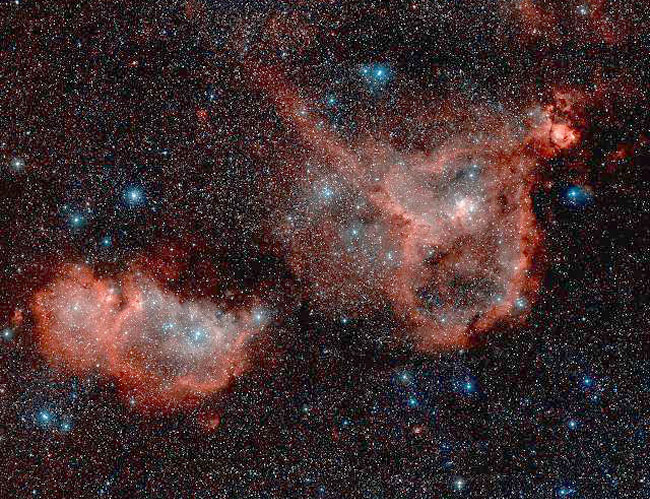
(Images courtesy of Google Image Search and Nasa's Astronomy Picture of the Day)

DOTR Lesson 2: Sky

Some basic research into the sky, the atmosphere and weather, and the solar system as part of DOTR Lesson 2 work.

What is the sky? What strikes me immediately, scanning through the wikipedia page (as good a place to start as any), is the rather ineffable nature of the sky, hard to nail down with a single definition. We begin with the understanding that the "sky" is the view of everything not-earth that can be seen from the vantage point of earth — the atmosphere, outer space (and we expand this by saying it is this same view afforded from the surface of "any astronomical object," by which I assume they mean, f'ex, meteors or other plants, not any object that happens to be incredibly large). During the day, you could reasonably say that the sky is only our atmosphere and the few bits of our immediate solar system that manage to assert themselves: the sun, the moon, sometimes very bright planets or comets, but otherwise, the "sky" is that approximately 11 km of atmosphere closest to the earth's surface, where most of its weather takes place. Yet at night, "sky" becomes almost infinite, from our perspective reaching out into the darkness of space where stars trillions of kilometers away are shining, reaching their light towards us from the past. The night sky is (nearly) infinite in both space and time, then, while the day sky is wrapped close around the land. Poetically, you can imagine the sky — as an intentional object (phenomenologically speaking) — breathing or pulsing, in and out, wider and closer, as the earth turns. Strange that the dark, so often associated with a turn inwards towards the center, is also the time when the sky "expands" the farthest.

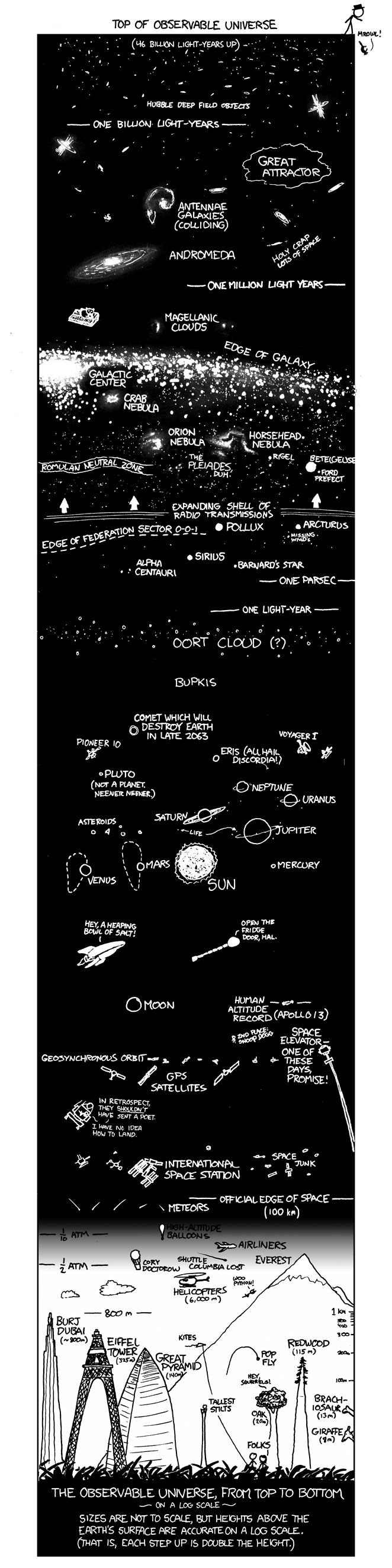
Height, by xkcd.comThe atmosphere. Some fun facts about the earth's atmosphere. Dry air contains about 78.09% nitrogen, 20.95% oxygen, 0.93% argon, 0.039% carbon dioxide, and small amounts of other gases, as well as an average of about 1% water vapor. The atmosphere acts as a kind of gaseous "skin" enveloping the earth, that both deflects harmful radiation and retains a certain amount of heat from the sun, helping to modulate night and day temperatures.

The atmosphere has five basic layers, delineated according to temperature rise or fall. The troposphere begins at the earth's surface and extends to between 7 km (at the poles) to 17 km (at the equator); within this layer, temperature decreases with an increase in altitude, mainly because of heat transfer from the surface of the earth which makes the lowest part of the troposphere the warmest. The name derives from the Greek "trope" meaning to turn or overturn, and indicates the nature of vertical mixing that occurs within this atmospheric layer. The next layer, the stratosphere, extends from the upper edge of the troposphere to about 51 km, and within this layer temperature increases with altitude, limiting the amount of mixing and turbulence. The lower portion of the stratosphere contains the ozone layer, which can vary in thickness. The mesosphere extends from the upper edge of the stratosphere to about 80-85 km, and is defined by a decrease in temperature as altitude increases. The upper threshold of this level might be considered the "coldest place on Earth" (averaging around -85˚C or -121˚F). Above the mesosphere is the thermosphere, extending to about 690 km above the earth's surface, and in which temperature again increases with height. Within the thermosphere, the Kármán Line (at 100 km) marks what is commonly accepted to be the unofficial "boundary" between earth's atmosphere and outer space, as it indicates the place where the air becomes too thin to be practically useful for aeronautics purposes (in other words, in order to generate enough lift, a vehicle at this altitude would have to travel faster than the orbital velocity). Above the thermosphere is the exosphere, composed primarily of hydrogen and helium, with free-moving molecules so far apart that the atmosphere no longer behaves "like a fluid." Within the exosphere, temperature remains constant; although you could arguably describe the exosphere as ending at about 10,000 km, there really is no hard-and-fast line for its end — rather, it grows progressively thinner and thinner as altitude increases.

Light and color. The daytime sky appears blue because of Rayleigh scattering — shorter wavelength light (such as blue and violet) scatter more than longer wavelength light (such as yellow and especially red), giving the sky a blue gradient in which it appears lighter towards the horizon and darker towards the zenith, while the sun itself appears yellow due to longer-wavelength light from father away not being scattered (from outer space, the sky appears black and the sun appears white). Since I don't exactly understand this (though I have observed this effect with clouds), I'm going to quote directly from the wikipedia article on this one:
In other words, the red light scatters also; if it does so at a point a great distance from the observer it has a much higher chance of reaching the observer than blue light. At distances nearing infinity the scattered light is therefore white. Far away clouds or snowy mountaintops will seem yellow for that reason; that effect is not obvious on clear days, but very pronounced when clouds are covering the line of sight reducing the blue hue from scattered sunlight.

Weather and climate. I have no real insight to include on this particular topic, other than to note the usual distinction between weather (the hot/cold, wet/dry, calm/stormy, clear/cloudy, etc. descriptions) of a local area as the day-to-day changes and conditions, while climate indicates the patterns and averaging of weather in an area over an extended period of time. For more detailed discussion, I'll include the wikipedia page in the sources list. I can also make an effort to consult my National Audubon Society Field Guide to North American Weather on a regular basis and record the conditions in my local area as part of my daily diary.


Sources:

Thursday, October 28, 2010

Variations on the DOTR Symbol

Interweaving the Three Realms
This design is based on the Druid Order of the Three Realm's design of the combined triskelion and triquetra. The effect of the spiraling curves in the original symbol is so dynamic and yet so simple and elegant. Though I liked that design as it is, in some ways I felt like the spirals were too "outwardly" focused, if that makes sense. I wanted to bring each of the spirals in the interlace with the others... The idea of adding the flare to symbolize each of the three realms kind of came to me while I was doodling.

I'm not sure what I'm going to do with the design, but it's been bouncing around in my brain for at least a week and when I did finally get a draft down I was pretty pleased with it. However, it's the best I could do without a compass and, you know, talent... I'm thinking of eventually turning it into an altar tile or plaque, and maybe even a tattoo.

After putting out a request on Facebook for folks interested in touching up the design and going for a more professional "look," I received two beautiful renditions. The first, from Christopher Lee Horne:
As you can see, I incorporated this image into the header of this blog.

The second came from Dylan Thomas:

Also quite striking. I want to express my gratitude and appreciation to both!

Wednesday, October 27, 2010

DOTR Lesson 2: Sky


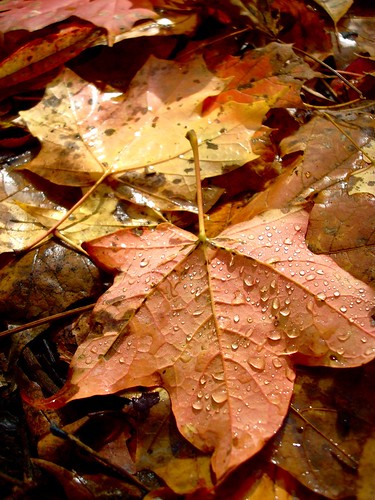
leaf after rain


Sunrise in Autumn

I saw
for one brief moment
the light
creeping over the hill
between horizon and fog,
everywhere suffused
with the rose and gold
of morning —
as though we turned
and moved
in joy,
as though we, like all beings,
could reach out
our hands
to cup the day and drink.
The sun rose into cloud,
obscured.
What had lingered
rustling in the shining
crowns of the trees
retreated
into mist.
Now the rooftops
and the bark of the trees
glisten
darkly
with the rainy
dawn and gloom
and everything is still
and wet
and shadowless.
Peace, friends, I say
to the trees.
This too is a kind of light.
And like them,
like all beings, slowly
I open my hands.