Showing posts with label space. Show all posts

Wednesday, December 8, 2010

Meditations on Brigid: Creatrix, Goddess of Creativity

Brigid, Bright Creatrix,
Goddess of Creativity,
Source of All,
what message do you have for me?

Death: Not creation from nothing, but the creativity of rebirth and renewal is her nature, the cycles of destruction and creation in the wild, passionate dance of grief and joy, sorrow and love, bound together and unfolding in ever-new forms and ways. The creation of transformation, the embrace of fire that both consumes and transforms, the new is a seed within the old, hatched amidst difficulty and, yes, even fear.

The grief of the ancestors in my blood and bones, the land I walk upon, you are the Ancestor of my ancestors, the source in the stars themselves, the ringing clash of metal, hiss of steam in the darkness and star-pierced night of space. Before there was a land, there was fire and water, there was you, the forger of star-stuff, complexity building upon complexity in the furnace at the heart of the countless suns, and the scattering of star-ash across the galaxies. We arise from your burning self-sacrifice and the joy of your passion and song, your voice like harp strings humming and thrumming in tension between life and death, strung between earth and sky, taut in our hearts, our throats, our hand-weavings as we do our work. All creativity is transformation, the willingness to dance as a partner of death, to carve away and reform, re-imagine. The ember of creation is the last remnant of a slow-dying fire, smoldering warmth and with its last light giving the spark to set going a new blaze.

Praise to you, Source and Nothing, Creator and Death alike, embracing the world with a love that sustains and transforms. My gratitude for your presence in my life, Exalted Brigid.

Awen.

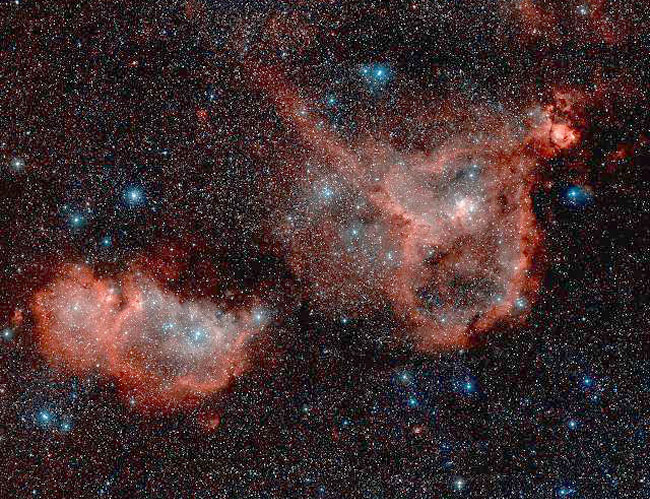
Brigid, Lady of the Star Fire

The Brighid Nebula by Randall Klopping

Friday, November 19, 2010

DOTR Lesson 2: Sea

It began with a few tenuous notes turning and echoing out across the waters, the keening of the violin striving against its own tension and yearning. I was there, on the same familiar rocky cliff that curved in around a small bay, the dark waters of the ocean stretching out far beneath me. The murmuring wash of waves among the pebbles of the beach below, rocking in rhythm until the music faded again into silence.

Above me, the stars began to slip out into the night, one by one, as though disrobing from the dark veils of the night sky. One by one, they turned and shot a gasp of brilliance blazing out in a spiny halo of light around them, then pulled back again, glistening and humming with a silent energy. I lifted my head to ask them for their wisdom. It seemed as though one beckoned to me, glimmering more brightly than the rest. The vertigo of a wild night sky thrown open from horizon to horizon swept over me as my gravity seemed to shift — and then before me, solid as stone it seemed, a staircase spiraled upwards into the starscape. Step by step I climbed, my feet steady, my eyes on the scattered specks of light. Each step fell thick and heavy as though on stone draped over with the deep, plush fabric of night and darkness and stillness. As I reached the final stair, the star before me stepped close as a woman, dark and brilliant with features that seemed to shift as she turned, as though I gazed into her eyes from across countless light years. She smiled, and lifted her hand to caress my cheek and temple.

Then all at once, her other hand was at my throat, grasping my jaw firmly. With one quick motion she wrenched my face away, palm hard against my forehead, and I felt my spine snap as my body crumpled beneath her hard, cold fingers.

My body tumbled as it fell from the sky, loose and undone. I felt almost relaxed, my body buffeted and slowed by the wind, as though some tension in me had snapped and let me drop. I fell like a limp dead thing, which is what I was, and when I hit the ocean's surface, it gave way with almost as little resistance as the air, opening its dark mouth in a crater-like wave that closed over me again as I sank down beneath the waters.

Down and down I sank, making no attempt to swim or even draw a breath. My body became as heavy and dark as the oceans themselves, and creatures glided past me in the dark glistening a wet gold, slipping in and out of sight almost like stars. It seemed to me that all this time, I could see the stars shining above me, above the surface of the water, though only dimly — so dim that perhaps it was no more than a memory. My body lay on the rough bottom of the sea for a long while, its limbs swayed only by the slow, sluggish motions of the currents. I do not remember making the decision to move again — and maybe it was only the ocean itself that gradually pushed and pulled and turned me towards the shore — but eventually I found myself on hands and knees, stumbling and crawling up the pebbled beach, waves dragging at me as I gasped and sought for a hold.

Exhausted, I could not go far, but sat just above the highest reach of the waves where they ran themselves out between the wet, rounded stones. I sat for a while, catching my breath as it returned and letting the ocean water drip from me until I found I was quite dry, though chilled beneath the night sky once more. Then down the beach came the white hound, old companion of this place, bounding with joyful greeting towards me. I flung my arms around her in an embrace and buried my face and hands in her warm, dog-scented fur. Life, with that warmth and panting breath and bounding joy, began to return to me and I felt happy and grateful to have found her again after so long an absence.

Yet, in the midst of our joyous reunion, she stopped — and a low growl began to build in her throat. At first, I thought she was growling at me, and a moment of panic at another betrayal swept through me. But then I realized she was looking past me, towards a figure that loomed up out of the dark some ways down the beach. I turned and ventured closer — the dark figure outlined against the sky seemed huge and thin, featureless as worn stone, and I soon realized it was not a person, but a statue: a thin, lank, faceless man standing on a dais, like an oscar carved from rock and weathered by the sea and wind. I turned to reassure the white hound by my side, who glanced up at me with a look of that showed a clear dislike for the figure — then the dog squatted and pissed on the dais and trotted off up the beach again as though her sentiments had been made clear. I followed her back to where we had been, and sat down once more on the pebbly shore, the dog curled up on my left while my hand ran over her long, white fur in gentle strokes.

Then there was the dark star goddess beside me again, sitting with her knees drawn up to her chest, feet bare against the wet rocks, the hem of her deep blue robes clinging with damp to the stone. I was not afraid, but comforted as she drew my head down to rest on her shoulder and she stroked my cheek again just as I stroked the dog's warm fur. Though she did not say a word to me, I came to understand the killing blow she'd dealt me was not a violence or punishment, but her gift to me: a change in perspective that sent me plummeting into the depths. Too many are striving towards the stars, climbing those steep ladders and struggling with all their might towards the heights to catch a glimpse of something marvelous.

She turned a little so that we could look one another in the eye. Sitting there on the beach, she was barely taller than I was, her face shifting in and out of shadow, her eyes shining, her hair seeming sometimes wet and dark as to be almost black in long, flowing locks, and sometimes like a liquid fire, deep amber and auburn, strands curling and licking along the pale, perfect skin of her face and shoulders like tongues of flame. Leaning forward, she pressed her little lips against my forehead in a lingering kiss. I felt the warmth of that kiss seep into the depths of me, blossoming and opening outwards from within. The sky above me seemed expansive and infinite in the darkness. The ocean spread like a black, rippling plain of reflected starlight so vast and great and deep that it stole all breath from my body. The stone and earth below me shuddered with solidity and power, hard and warm and heavy like a great weight on which I walked like some delicate, fragile thing. The three realms loomed in majesty, surrounding me in glory where I sat stunned in awe on the threshold, that liminal space where land and sea meet sky. I was so utterly small — and yet, a witness to this greatness, I held all this in the intimacy of my own body, concentrated and unfurling through the three realms, the elements of my being a microcosm of this larger world.

The goddess of starlight and transformation leaned away from me, a small, slight figure full of power and primordial energy churning in the dark. This is it, she seemed to say, this is what you are here for. To be the witness to the wild, overwhelming wonder of the world — to be small and simple beneath the sky, to drift light and buoyant upon the sea, to dance fragile and always half-rootless across the land. No other view is better than this one right here, no other view is meant for you. You cannot become big by strife and struggle. You can only participate in the vastness of creation, you can only join in relationship with the greatness of the world, by staying here to attend to your place in it with openness and gratitude. You are not in service to your self alone; you are in the service of greater things than you.

The kiss lingered still, flooding my senses with the slow opening of light and energy and song. I felt as though I were slipping into deeper trance... yet soon I found myself opening my eyes, the meditation over, the mundane room around me and the candle flickering in its holder, amber-rose in the bright sunlight thrown in slanted rays across the coffee table. Still, the energy flowed through me, and the vision remained.

Tuesday, November 9, 2010

Earth/Stars

Be humble for you are made of earth;
Be noble for you are made of stars.

(Serbian proverb.)

Brigid of Amber, Brigid of the Stars

I frequent a forum called The Cauldron, where I belong to a flamekeeping Cill dedicated to the goddess Brigid. I began flamekeeping with them just before Imbolc of last year. (Mine is the third day in the rotation of twenty, and my shift has fallen more than once on days of special personal significance to me — which others have told me often happens during the first year of flamekeeping for a new Cill member.)

Recently, some wonderful and fascinating discussions have been going on in the Celtic Polytheism SIG, "Hazel and Oak," focusing on Brigid of the Forge as a creatrix/star goddess. The conversation has sparked (no pun intended) the suggestion of designing a group ritual. I want to plunge in and get involved in this work, journaling some of my thoughts and potential liturgical ideas on this blog, so I thought I would just mention this as an introduction for future reference.

I'll add to this later, but for now, here is a response I posted to the forum tonight, regarding the possibility brought up by others (and echoed in my own personal ritual experiences over the summer) of amber being a "stone" sacred to Brigid.

Part of the reason I did the three gifts meditation was to prepare for my trip to Northern Ireland (for a spiritual retreat focused on peace activism and social justice), and I was hoping for some images/icons to "carry with me" to meditate on during my time there. When the shadowy, robed figure outlined against the flames of the sacred fire reached into the heart of the fire and handed to me a droplet of amber, I think I actually laughed out loud in the middle of the ritual.

It suddenly seemed so obvious to me: first and foremost, amber as a "stone" of living fire or fire-in-water, the life-blood of the tree borne of the intermingling of the underground waters drawn up from the roots and the sunlight cascading down from the sky, cupped and drunk by the leaves. The prayer I use during my flamekeeping shifts begins: "Fire and water in the earth of my body, I keep your sacred flame." Amber as the sap or resin of ancient trees seemed like the perfect symbol of this idea.

And then, of course, is the fact that amber is especially well-known for containing the preserved remains of ancient insects, some of which contain the blood/DNA of ancient animals. So in another way, amber represented the "preservation and protection of life" and the continuation of ancient traditions and primordial energies or spirits. The fact that I was going to a retreat in the land of my ancestors that was focused on peace activism seemed to align perfectly with this idea.

I have wondered if anyone else made this connection to amber. While I was on the retreat, just after I'd found the amber sun amulet at the farmer's market, I had a discussion with someone at the retreat who was a former Pagan — he pointed out that amber and jet was a common combination for jewelry (especially among Wiccans, I think, if I'm remembering correctly what he said). But he said that amber was mostly associated with the God rather than the Goddess, being more "active/yang" and masculine. This deflated me a bit and so I kept my musings about any possible Brigid-amber connection to myself. So it's been wonderful for me to see others validating that connection and sharing some of their own thoughts!

And in keeping with the themes of fire-on-water and creation, I suddenly see amazing connections to the very first of the Rosary Poems I wrote back in college (of which, at the time, my advisor said, "Some poems just show up whole and perfect the way they are, like a gift"):

Annunciation

The light shines in the darkness,
and the
darkness has not overcome it. JOHN 1:5


Her yes becomes flesh
in flesh, white-winged fire swept
along sweat as if over the agitation
of waves, sharp spine of sunlight
in a slow serpentine across
the waters of her body —
there is no rushing it, no cascade
into the long cry of rising — only
a breath, a word, and the pouring
in of everything, even God.


More thoughts on all of this when I'm a bit more "together" and coherent.

Friday, November 5, 2010

DOTR Lesson 2: Sky


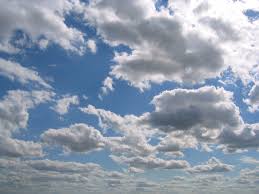
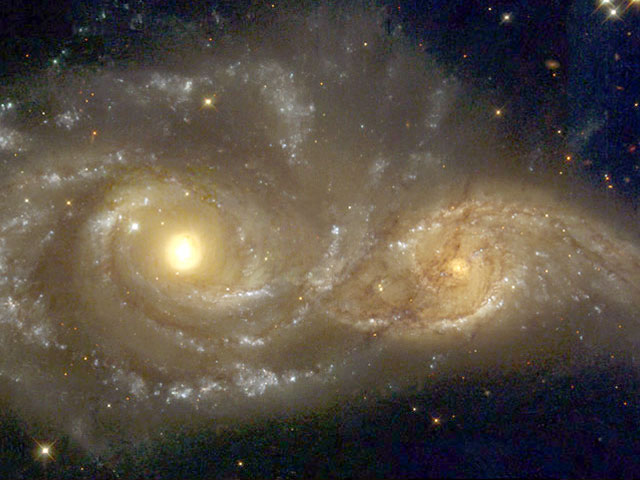
(Images courtesy of Google Image Search and Nasa's Astronomy Picture of the Day)

DOTR Lesson 2: Sky

Some basic research into the sky, the atmosphere and weather, and the solar system as part of DOTR Lesson 2 work.

What is the sky? What strikes me immediately, scanning through the wikipedia page (as good a place to start as any), is the rather ineffable nature of the sky, hard to nail down with a single definition. We begin with the understanding that the "sky" is the view of everything not-earth that can be seen from the vantage point of earth — the atmosphere, outer space (and we expand this by saying it is this same view afforded from the surface of "any astronomical object," by which I assume they mean, f'ex, meteors or other plants, not any object that happens to be incredibly large). During the day, you could reasonably say that the sky is only our atmosphere and the few bits of our immediate solar system that manage to assert themselves: the sun, the moon, sometimes very bright planets or comets, but otherwise, the "sky" is that approximately 11 km of atmosphere closest to the earth's surface, where most of its weather takes place. Yet at night, "sky" becomes almost infinite, from our perspective reaching out into the darkness of space where stars trillions of kilometers away are shining, reaching their light towards us from the past. The night sky is (nearly) infinite in both space and time, then, while the day sky is wrapped close around the land. Poetically, you can imagine the sky — as an intentional object (phenomenologically speaking) — breathing or pulsing, in and out, wider and closer, as the earth turns. Strange that the dark, so often associated with a turn inwards towards the center, is also the time when the sky "expands" the farthest.

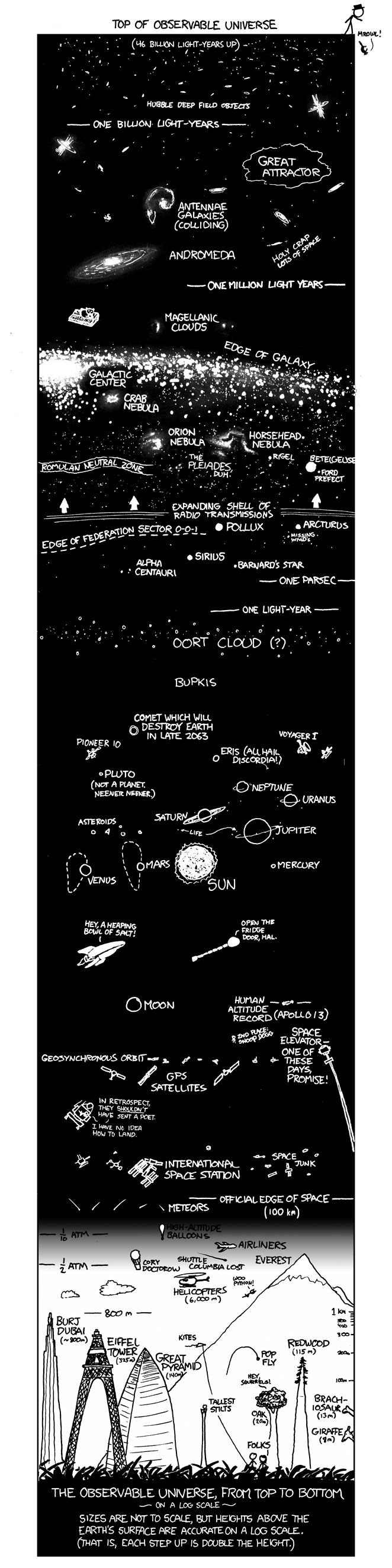
Height, by xkcd.comThe atmosphere. Some fun facts about the earth's atmosphere. Dry air contains about 78.09% nitrogen, 20.95% oxygen, 0.93% argon, 0.039% carbon dioxide, and small amounts of other gases, as well as an average of about 1% water vapor. The atmosphere acts as a kind of gaseous "skin" enveloping the earth, that both deflects harmful radiation and retains a certain amount of heat from the sun, helping to modulate night and day temperatures.

The atmosphere has five basic layers, delineated according to temperature rise or fall. The troposphere begins at the earth's surface and extends to between 7 km (at the poles) to 17 km (at the equator); within this layer, temperature decreases with an increase in altitude, mainly because of heat transfer from the surface of the earth which makes the lowest part of the troposphere the warmest. The name derives from the Greek "trope" meaning to turn or overturn, and indicates the nature of vertical mixing that occurs within this atmospheric layer. The next layer, the stratosphere, extends from the upper edge of the troposphere to about 51 km, and within this layer temperature increases with altitude, limiting the amount of mixing and turbulence. The lower portion of the stratosphere contains the ozone layer, which can vary in thickness. The mesosphere extends from the upper edge of the stratosphere to about 80-85 km, and is defined by a decrease in temperature as altitude increases. The upper threshold of this level might be considered the "coldest place on Earth" (averaging around -85˚C or -121˚F). Above the mesosphere is the thermosphere, extending to about 690 km above the earth's surface, and in which temperature again increases with height. Within the thermosphere, the Kármán Line (at 100 km) marks what is commonly accepted to be the unofficial "boundary" between earth's atmosphere and outer space, as it indicates the place where the air becomes too thin to be practically useful for aeronautics purposes (in other words, in order to generate enough lift, a vehicle at this altitude would have to travel faster than the orbital velocity). Above the thermosphere is the exosphere, composed primarily of hydrogen and helium, with free-moving molecules so far apart that the atmosphere no longer behaves "like a fluid." Within the exosphere, temperature remains constant; although you could arguably describe the exosphere as ending at about 10,000 km, there really is no hard-and-fast line for its end — rather, it grows progressively thinner and thinner as altitude increases.

Light and color. The daytime sky appears blue because of Rayleigh scattering — shorter wavelength light (such as blue and violet) scatter more than longer wavelength light (such as yellow and especially red), giving the sky a blue gradient in which it appears lighter towards the horizon and darker towards the zenith, while the sun itself appears yellow due to longer-wavelength light from father away not being scattered (from outer space, the sky appears black and the sun appears white). Since I don't exactly understand this (though I have observed this effect with clouds), I'm going to quote directly from the wikipedia article on this one:
In other words, the red light scatters also; if it does so at a point a great distance from the observer it has a much higher chance of reaching the observer than blue light. At distances nearing infinity the scattered light is therefore white. Far away clouds or snowy mountaintops will seem yellow for that reason; that effect is not obvious on clear days, but very pronounced when clouds are covering the line of sight reducing the blue hue from scattered sunlight.

Weather and climate. I have no real insight to include on this particular topic, other than to note the usual distinction between weather (the hot/cold, wet/dry, calm/stormy, clear/cloudy, etc. descriptions) of a local area as the day-to-day changes and conditions, while climate indicates the patterns and averaging of weather in an area over an extended period of time. For more detailed discussion, I'll include the wikipedia page in the sources list. I can also make an effort to consult my National Audubon Society Field Guide to North American Weather on a regular basis and record the conditions in my local area as part of my daily diary.


Sources: